 Made in Humane Club



She wanted to build a Sherlock Holmes mystery. We built a construction site instead. Here’s what happened.
My nine-year-old daughter Sabi was sitting across from me at her study table, genuinely annoyed.
“But WHY can’t I just build the Sherlock Holmes game?”
She had an entire mystery mapped out in her head( clues, suspects, a big reveal) and I was asking her to build something simpler first. The disappointment was real. She slumped back in her chair and stared at the ceiling.
I didn’t blame her. It was a great idea. It was just the wrong idea for day one.
I sat with that for a second. I’d planned this session carefully but I hadn’t planned for quite this level of resistance, this early. There was a version of me that would have just let her build the Sherlock Holmes game and redirected later. I’m glad I didn’t. But in the moment, I wasn’t certain.
Start with life, not logic
I opened with her morning routine, not theory.
Sequencing, I told her, is just the idea that order matters. Can you brush your teeth before you put toothpaste on the brush? Can you wear your shoes before your socks?
She laughed. Obviously not.
That’s sequencing. Order matters. Do things in the wrong order and the whole thing falls apart. Not because you did the wrong thing, but because you did the right thing at the wrong time.
That’s the thing about sequencing: kids already know it. They just don’t have the vocabulary. Once you name it, it clicks.
We went through a few more examples together. A recipe: you don’t put the cake in the oven before you’ve mixed the batter. A building: you don’t paint the walls before you’ve put them up. Getting dressed: you don’t put a jumper on before your shirt.
How she chose what to build
Once she understood the concept, I gave her the challenge: design a game that uses sequencing. Your rules, your theme, your design.
One condition: think it through first. Write it down before we build anything. The Google Doc is the algorithm.
Her first idea arrived immediately. A Sherlock Holmes mystery. She was off: mapping clues, sketching suspects, planning a dramatic reveal. The energy was great. The ambition was real.
And it was entirely wrong for day one.
Building a mystery game well requires things she didn’t have yet: conditional logic, narrative branching, deductive structure. She’d be trying to build a roof before the walls were up, which, as it turned out, was rather on theme for what came next.
I didn’t shut it down. I told her: this is a great game. We are going to build this game. But not today. You need more tools first and we’re going to get them one at a time. We put it in the backlog.
Then I asked her: think of something from real life. Something with steps that genuinely have to happen in a fixed order. Something where if you get the sequence wrong, it’s visibly, obviously broken.
She didn’t have to think long. We’d recently finished a house renovation.
The design doc
She decided to build a construction game. You’re building a house. Complete each phase in the right order or the whole thing falls apart. She started writing down steps, foundation, walls, roof, but quickly got stuck.
She didn’t know the nuances: what actually happens between laying the foundation and putting up the walls? What comes before the roof and what comes after? The sequence had gaps and she knew it.
So she stopped. She opened a tab, read about how buildings are actually constructed and then came back 20 minutes later with a refined list.
It wasn’t just a list of steps but a complete game design.
Build a House

Mission - You have to build a house within a limited period of time, in the correct order of steps.

Variables

* Time - You have just 28 days to do these tasks
* Money - You have just 1,500 rupees
* Energy -  You have just 120 energy pts

Unexpected Variables

* There is GRAP 3 going on so you have to shut down work for a week.
* There is a rainstorm. You must cover the building properly which will cost rupees 500.
* There is an MCD issue. You have to shut down work for 5 days.

Rules
* If the correct order is given then continue
* If an incorrect order is given then a penalty will be there in which you lose 100 rupees, 20 energy pts, and 4 days of time.

Steps

1. Clean land
2. Build base
3. Build frame
4. Add walls
5. Add roof
6. Add doors/windows
7. Add water system
8. Add electric wiring
9. Turn on lights
10. Paint house
11. Finish floors
12. House ready
Look at that. She invented unexpected variables. She gave the penalty system three dimensions (money, energy, and time) without me suggesting it. She included real-world disruptions she’d observed during our actual renovation: GRAP restrictions (Delhi’s pollution-based construction bans), MCD (Municipal Corporation of Delhi, the body that issues construction approvals) approvals, monsoon problems.
The design doc wasn’t an exercise. It was a nine-year-old telling a complete story about how construction actually works, with all the variables she’d seen her parents worry about.
Watch for these green flags with your own child. They tell you it’s landing:
- They catch their own mistake before you do.
- They ask “but what if…?” unprompted.
- They want to add a step you didn’t suggest.
When you see these, resist the urge to jump in. The productive struggle is the point.
Design → Build → Ship
With a solid design doc in hand, we opened ChatGPT.
I want to be precise about what happened here, because it’s easy to misread. She wasn’t watching me build something. She wasn’t following a tutorial. She was the designer handing a brief to an implementer.
What she typed (roughly)
Build me a browser game where a player has to complete house construction steps in the right order. If they do a step too early, show an error and explain why it's wrong. If they complete all steps in order, they win. Can you create this into a single file HTML.

Use only black and white color. The game is built only for mobile screens but needs to work on a laptop. Use font Lato. Make the title of the game big and bold. The unexpected variables should pop up randomly but not frequently and each unexpected variable should come only once. The game should get over when the player runs out of time, money, or energy. The player should be able to see which step he / she has done. Show pop up only when the player selects the wrong option. Add play again button once game is over.
Then she copy pasted what she had written in Google Doc.
That prompt worked because the thinking behind it was solid. The AI had something real to implement. Garbage in, garbage out: it applies here exactly as it does in any professional design process.
The game came back. We tested it together. The roof step was appearing before it should. A sequencing error in the output, caught by the person who designed the sequence. She told the AI what was wrong. It fixed it.
That took twenty minutes. The next two hours were harder.
She wanted the steps to shuffle every time a player hits Play Again, so the game wouldn’t be memorisable. Reasonable design instinct. Completely correct thinking. And ChatGPT kept getting it wrong. The shuffle wasn’t working. The steps were coming back in the same order every time, or scrambling in ways that broke the game logic.
She prompted. Fixed one thing, broke another. Prompted again. By the twelfth attempt she was on the verge of tears, genuinely frustrated. The kind of frustration that comes from knowing exactly what you want and not being able to get there.
I didn’t fix it for her. I asked her to describe the problem out loud, precisely. Not ‘it’s not working’: what specifically is not working, and when? She took a breath and tried again.
It took twelve prompts in total before the final version worked the way she’d designed it. Somewhere in the middle of all this, she copy-pasted an output and the screen went blank. She stared at it. “Mum, it stopped working.”
I glanced over. ChatGPT had returned JavaScript only, no HTML wrapper. She’d pasted raw JavaScript into the browser and it had nothing to run inside.
“HTML is missing,” I said.
She went very quiet for a second. Then fixed it.
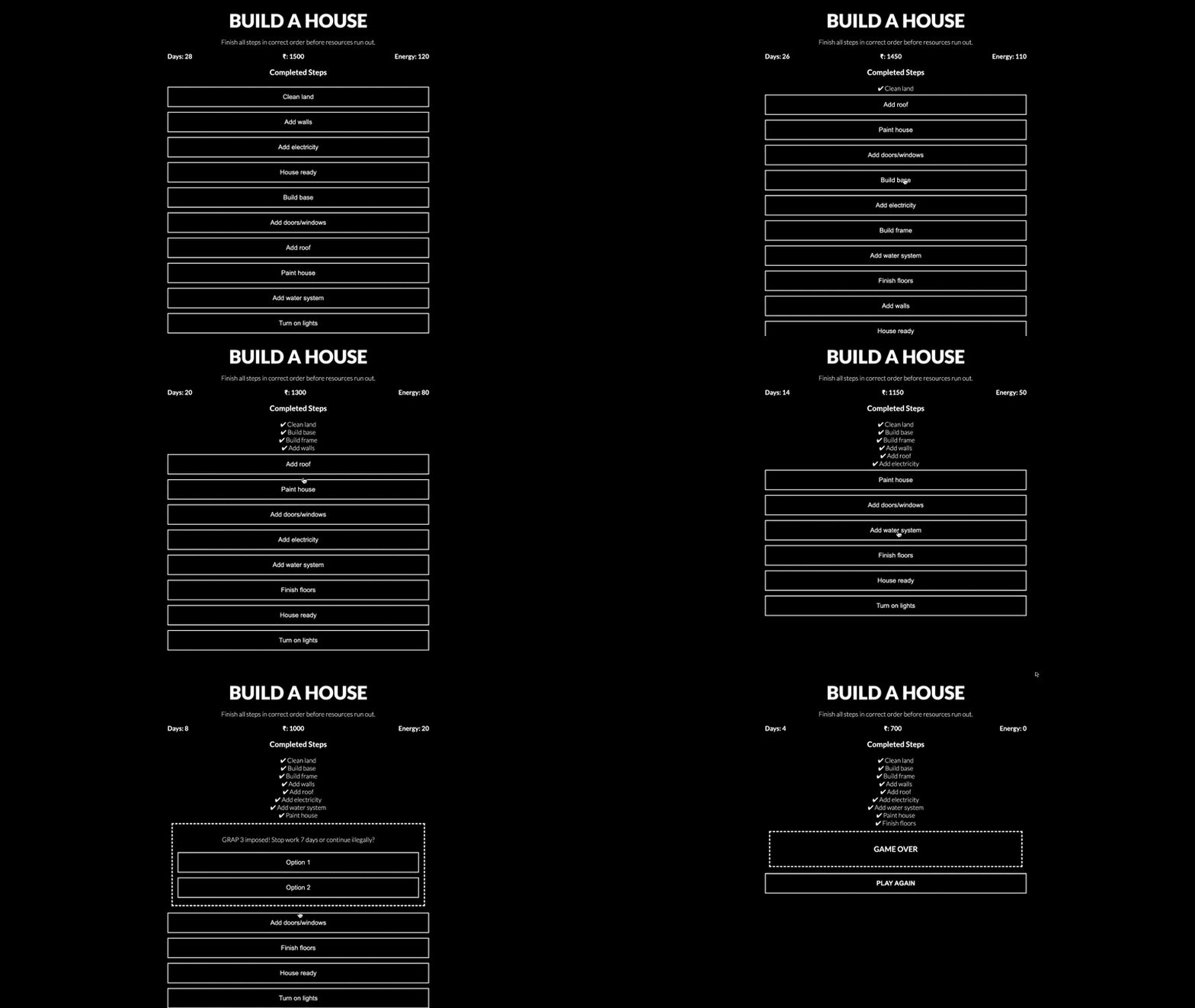
The final game had a working shuffle, penalty logic for wrong-order attempts, three resource variables, and real disruptions built into the unexpected events. It took twelve prompts to get there. She built it.
I watched her close the laptop and I didn’t say anything for a moment. I wanted to say: look what you just did. But I didn’t. The thing about this kind of learning is that naming it too loudly can shrink it. She knew. I could see it in how she sat.
What this is actually building
It wasn’t the finished game that surprised me. The game was good, but the game was expected.
It was the research.
The moment she hit the knowledge gap in her construction sequence, she didn’t ask me to fill it in. She didn’t guess. She stopped, found a source, read it, and came back with better thinking.
I praised the research, not the result. “You found a gap in your own thinking and you went and fixed it. That’s the skill.” She seemed mildly pleased and immediately wanted to know when we could make it harder.
That moment is what I keep coming back to when people ask what I’m actually teaching her. Because I keep saying it’s not coding, and people nod, and then ask which programming language she’s learning.
So let me be specific.
The research rabbit hole was the point. The Sherlock Holmes backlog was the point. The design doc she had to fill in before touching any tool, that was the point. Every constraint in the session was designed to put her in a situation where the quality of her thinking visibly mattered. Where a gap wasn’t just an abstraction. It was something broken in her own work that she could see and fix.
That instinct: to close the gap yourself rather than work around it, to care about the thinking before the output, isn’t a coding skill. It’s not even a tech skill. It will be just as useful if she becomes a lawyer, a doctor, or something that doesn’t exist yet.
The sequencing was just where we started. ⚡️
What I didn’t understand on day one was that the Sherlock Holmes resistance was the whole session. Not an obstacle to get past. It was the point itself. A child who wants something badly enough to be genuinely annoyed when told to wait is a child who will work for it. That’s what I was looking for, and I almost redirected it away.
What’s next
The Sherlock Holmes game is still in the backlog. She asks about it occasionally.
Next up is patterns: spotting what repeats, predicting what comes next. She’s been watching cricket scores for years without knowing she was already doing it. That’s post two.
Your turn
Use this section as a reference before and after the session. The memoir above is our story. This is the kit that you can follow.
The concept
A sequence is steps in order. That’s the whole concept. What makes it interesting at age 8–12 is the next question: which steps are fixed and which are flexible? A recipe has both. So does getting dressed. So does every program ever written.
Your child already knows this. They just don’t have the word for it. Your job in this session is to give them the vocabulary, then give them a situation where the gaps in a sequence become visible.
Green flag to watch for: your child catches a sequence error before you point it out. When that happens, the concept has landed.
Try this
Ask your child to explain how to make a sandwich to someone who has never heard of one. Every time they skip a step, point it out. Gaps in a sequence are bugs. That one exercise makes it completely concrete.
Before the design challenge: a screen-free activity (15 minutes)
Write out 6–8 steps from any familiar process on separate pieces of paper: getting dressed, making breakfast, building with blocks. Shuffle them. Ask your child to put them in the right order.
Once they’ve ordered them: deliberately swap two steps. Ask: which steps have to be in this exact order? Which could you swap without breaking anything? That distinction (fixed vs flexible steps) is the concept at its most useful.
Going further
If your child races through this:
- Ask them to find a real set of instructions: a recipe, an IKEA manual, anything and identify one step that is in the wrong place or missing entirely.
- Add a second unexpected variable to the construction game, one they design themselves, drawn from something they’ve actually observed.
If your child needs more time:
- Stay with the sandwich exercise longer. Five different examples of sequences from daily life before moving to the design challenge. The concept needs to feel obvious before the build begins.
- Reduce the construction game to six steps instead of twelve. A shorter sequence with the same logic is the right starting point.
New here? Start with the series introduction. Parent’s Guide: Computational Thinking for Pre-Teens