 Made in Humane Club



She spent four days trying to fix a game that couldn’t be fixed. The conditions made perfect sense in her head. They made no sense to anyone else.
If this, then that. But only then.
Conditions, I told her, are the decisions a system makes based on what’s true at a given moment.
She already knew this. She’d been living inside conditions her whole life.
If the bag is packed the night before, mornings are calm. If it isn’t, they aren’t. She’s experienced that consequence more times than either of us would like to admit.
If it’s the right time of day and the weather is good, they go to the park. If it’s too sunny, they don’t. If it rains, they don’t. Multiple conditions, all of them have to be true at the same time. Miss one and the plan changes.
Every game she’d built so far had conditions running quietly underneath it. The skull when a robot wins: that’s a condition. The game ending when a wrong option lands in the wrong bucket: that’s a condition
The interesting question about conditions isn’t whether you understand them conceptually. It’s whether you can write them precisely enough that a player, someone who hasn’t seen the design doc and doesn’t know your intentions, can follow them through to a logical outcome. A condition that makes sense to the designer and a condition that makes sense to the player are not always the same thing.
That distinction took five days to land. And it required burning a quest to the ground to get there.
I want to be honest about what those five days felt like from my side. It was the hardest stretch of the series to hold. She was working hard. The thinking was serious. And I kept having to say: it’s still not working. That’s a difficult thing to keep saying to a child who is visibly trying. The temptation to move on i.e to call it close enough and tick the box, was real.
How she chose what to build
She came to this session with the theme fully formed. A quest at midnight. An owl guarding a map. Dungeons with traps. Mystical books that might contain a duplicate. Competitors who rush to the spot if you make noise. A witch. A ghost. A potion that must not touch the gem.
She’d been reading fantasy and adventure stories for years and had noticed, without naming it, that good stories are built on conditions. Every branch in the narrative follows from a choice the character made. She wanted to build that.
She wrote a detailed document. The structure was genuinely ambitious. Here is what she had:
The Midnight Quest

Mission: Find the precious mystical gemstone before your competitors.
The journey is dangerous, so follow the conditions carefully or you’ll fail. Three mistakes and the game is over. The game has three levels—make the right choices to progress.

Variables:
Time =  15 minutes per level
Energy = 10 energy pts per level

Level 1

Question 1: In order to get books, you must find a map.
Owl sleeping — sneakily do it without waking it up
Owl sleeping — I wake it up
Owl awake —

If an owl is sleeping and it is midnight, then you get the map. The owl becomes grumpy if you wake it up.
Options: Dance for owl to make owl happy / Wait for the owl
Consequences: If you dance, competitors rush to the spot. If competitors take the test first, a ghost will haunt you.

Question 2: If the map got lost —
Go to dungeons to look for clues OR flip through mystical books
Options: Dungeons — they might be traps / Mystical Books — less risky and easier

Level 2

Question 1: To use the map —
Options: Play some music OR summon a ghost and a witch to make a potion
Consequences: If you choose music, competitors will take the map. If you choose the potion, you get constant advice from a witch.

Question 2: The map leads to an Enchanted Library.
Options: Choose a book and a map / If you can't find anything meaningful, sneak out
Consequences: First option — extra weight. Second option — restricted to the library forever.

Question 3: The enchanted book has a map that leads to a gem.
Options: Follow the map and risk dangers at midnight / Wait and risk competitors catching up
Consequences: First option — ogres, witches, phantoms. Second option — map gets lost, gem never found.

Level 3

Question 1: To get the precious gem —
Options: Summon a ghost and witch / Update owl / Ask help from owl
Consequences: Ghost and witch will keep roaming with you. Owl help requires spending a lot of time making a potion.

Question 2: The potion must NOT touch the gem.
Options: Pour it on the location / Spend 5 hours doing a ritual
Consequences: Pouring might send it somewhere else. Ritual takes all your time and competitors catch up.


Instructions for ChatGPT
- Make this a single HTML file.
- The background should be dark purple.
- Everything should be written with neon green or neon yellow.
- The title should be “ The Midnight Quest ”
- Confetti should fall down in a spread out manner whenever the player gets a question right.
- The confetti should be brightly colored.
- The Instructions for the player should be written on the top. It should be written below the title.
- The conditions should appear in a question format.
- The consequences should be written underneath the conditions.
- The options should be written, below the conditions and consequences
- The variables should be neatly put in a box below the instructions for the player.
- The Unexpected Variables should pop in the correct order. 1 should pop in Level 1, condition 1. The 2nd one should pop in at Level 2, condition 1. The 3rd one should pop in at Level 3, condition 1.
- There should be a Play Again button on the bottom and in the middle of the game.
- When the player clicks on the Play Again button, the entire game should restart and the Game over should bounce away.
- The game should get over when the player makes a mistake. Make sure to write the reason they lost below.
- The game over line should slide in and a skull should be on it.
- When Level 2 starts, make a witch fly by the question.
- The entire question should be as is.
- All the unexpected variables should appear.
- All the questions should be there.
- The 6 minute variable should act as a timer.
- The a OR b should as options in the unexpected variable. The player should be able to click on them.
- The variables should be spread out horizontally.
- The game should get over when the player makes a mistake.
- The question should be written in a medium font
- Once the player answers the unexpected variable, the variable should go away.
- Make the font of the options larger.
- All of the options must be present.
- The play again button should be big.
- There should be sufficient space between the options and the play again button.
- Make sure that the confetti is spread out.
- My exact options should be there
- Do not shorten the options
- Make sure to add the consequences below the question.
- The option’s font should be slightly smaller than the questions font size
- The confetti should be spread out. It should look circular
- Once the game gets over, the player should not be able to click any option
- Don't shorten what I have written. In the consequences. The entire consequence should be there
I read it carefully. The imagination was vivid. The world was rich. And the conditions were almost completely disconnected from the player’s experience.
Look at Level 1, Question 1. The consequence of dancing for the owl is that competitors rush to the spot which leads to a ghost haunting you. The chain requires the player to predict not just the immediate consequence of their action but a second-order consequence involving competitors they haven’t met yet. There is no information in the game that would let a player reason toward this outcome. It’s not a condition but a trap dressed up as a choice.
Look at Level 2, Question 1. Playing music causes competitors to take the map. Why? How would a player know that? The condition exists in her imagination but not in the game’s logic.
There was also a witch flying around in Level 2. The constraint was already in place by this point: black and white, no animations, no confetti, logic visible on its own and it was doing exactly what it was supposed to do. The witch had nowhere to hide.
I pointed at one condition: if the player clicks mystical books, the game ends and asked her to read it from the player’s side. You’re in a dungeon. You don’t have the map. Someone tells you there are two options: dungeons, slow but safe, or mystical books, faster but riskier. You choose the books.
The game ends.
She saw it immediately. A real condition gives the player something that follows logically from what they did. This one just stopped the game.
She went back and tried to fix it.
Four days on a whiteboard
She didn’t disengage. That’s the first thing worth saying. For four days she kept coming back: thinking out loud, drawing on the whiteboard, filling pages with notes and scribbles and diagrams. She was trying to untangle a game that had become too complex to reason through.
She even reached for a framework she’d encountered in a book Back of the Napkin by Dan Roam (See, Look, Imagine, SHow) trying to separate what was visible in the game from what needed to be inferred and what could be designed differently. The thinking was serious and sustained.
But the game couldn’t be rescued because the foundation had a flaw that effort alone couldn’t fix. The conditions were built for the story she had in her head, not for the player trying to navigate from outside it. No amount of revision would change that because the problem was in the original design decision: consequences that made sense to the designer but were invisible to the player.
The constraint did exactly what it was designed to do: made the logic the only thing left to look at. And the logic didn’t hold.
I asked her to let it go and start something new.
She didn’t argue. She sat quietly for a moment. Then she turned to a new page in her notebook. That moment, choosing to let go of something you’ve invested four days in, is not a small thing. I didn’t make it smaller by commenting on it.
The design doc
She arrived at Baby Town.
When Vasuda was three months old, Sabi had written a song: Baby is walking in the baby town. She’d been watching a baby being managed, scheduled, soothed, fed, and kept calm for months. She knew the logic of it: the trade-offs, the timing, the sequence of decisions that determined whether a day went well or fell apart.
She sat down and wrote it all out.
Baby Town

Mission: The baby should stay calm throughout the day. She must also learn new things every day. You have to abide by the timer too. If you can't finish the mission on time, you lose the game. Each job takes a matter of hours. You also have limited energy. If you run out of energy, the game gets over. You have to be very efficient in doing everything. You have to choose the most efficient option which has to be correct.

Variables

Time — 12 hours
Energy — 300 pts

Unexpected Variables
- The baby fell down and got hurt in the park. She is crying loudly. What would you do?
Options: Distract her / Let her cry / Take her home

- The baby has to go to the doctor for a vaccination. What would you trade off?
Options: Sacrifice park time / Sacrifice nap time / Don't go at all

- The baby has a class to attend. What would you trade off?
Options: Sacrifice park time / Don't go at all

- The baby slept late last night. She is cranky and will be throughout the day. How will you try to make her fresh?
Options: Make her take a relaxing bath / Make her sleep early / Do something else

Rules
If the player chooses the wrong option, a penalty is applied: minus 5 hours and 100 pts.

Situations and Consequences

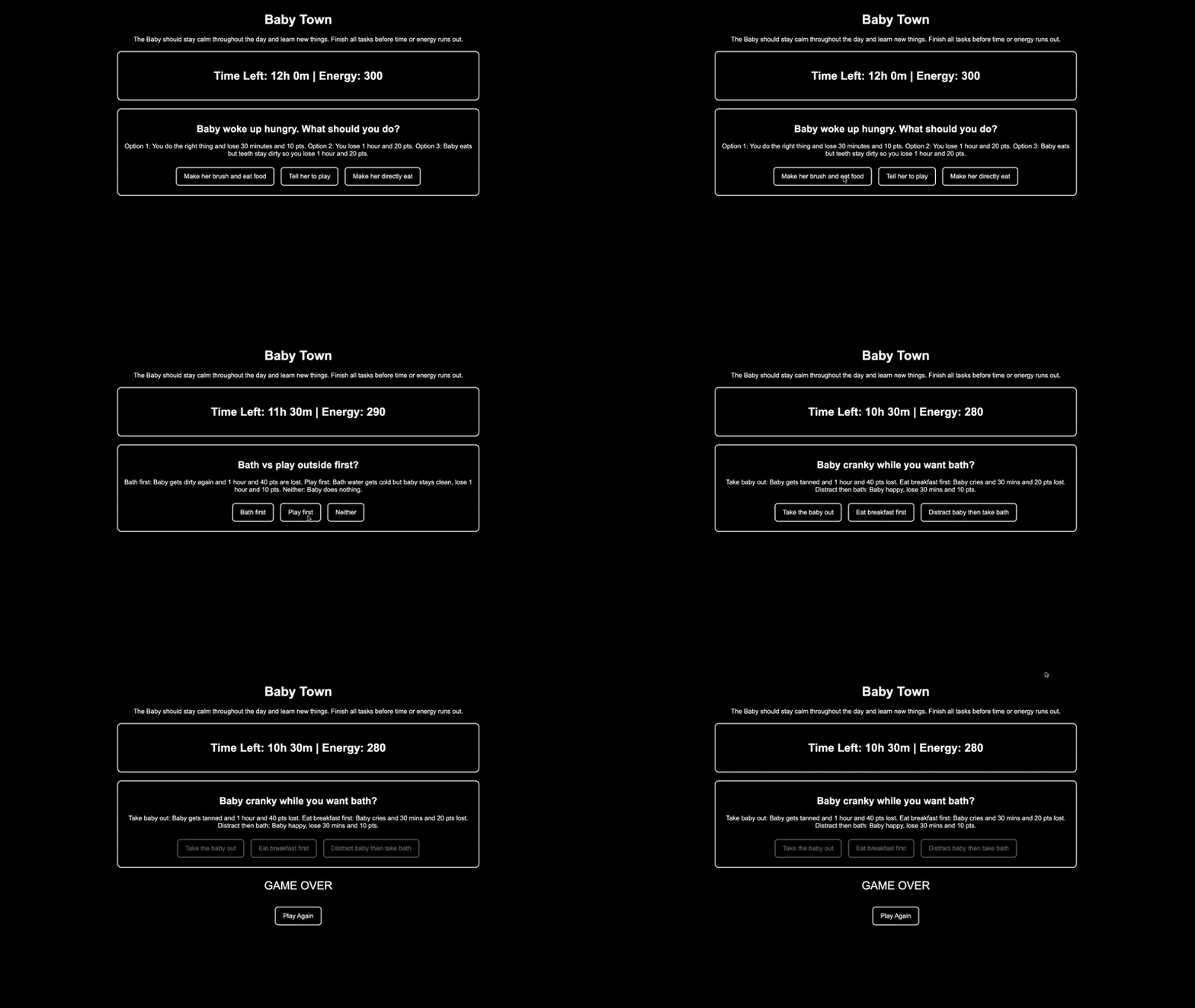
The baby woke up and is crying. She is hungry and eager to eat first. What would you do?
Options: Make her brush and eat food / Tell her to play / Make her directly eat
Consequences: Option 1 — right thing, lose 30 minutes and 10 pts. Option 2 — lose 1 hour and 20 pts. Option 3 — right thing but teeth stay dirty, lose 1 hour and 20 pts.

The baby needs a bath but wants to play outside. Both are good. Which should come first?
Options: Bath first / Play first / Neither
Consequences: Bath first — baby gets dirty again, lose 1 hour and 40 pts. Play first — bath water gets cold but baby won't get dirty again, lose 1 hour and 10 pts. Neither — baby unsatisfied, lose 1 hour and 20 pts.

The baby wants to go to the park but it's too sunny. You want a bath but the baby is getting on your nerves. What would you do?
Options: Take baby out / Eat breakfast first / Distract baby then take a bath
Consequences: Take baby out — baby gets tanned, lose 1 hour and 40 pts. Eat breakfast first — baby cries, lose 30 minutes and 20 pts. Distract and bath — baby stays happy, lose 30 minutes and 10 pts.

The baby is crying near her usual nap time. What would you do?
Options: Distract her / Make her sleep / Feed her food
Consequences: Distract — temporary, gets overtired, lose 1 hour and 10 pts. Sleep — effective, lose 1 hour and 30 pts but gain 3 hours and 20 pts. Feed — lose 1 hour and 10 pts.

The baby has woken up. She is hungry and you need to take her to the park before it gets too late.
Options: Feed her lunch / Quickly take her to the park / Make her sleep again
Consequences: Feed lunch — very fresh, lose 30 minutes. Take to park — stays cranky, lose 1 hour and 10 pts. Make sleep — won't sleep at night, lose 30 minutes and 10 pts.

The baby has gone to the park. It is empty. She is crying. What would you do?
Options: Play with her / Calm her down / Go home
Consequences: Play — she is happy, lose 30 minutes and 10 pts. Calm — still unhappy, lose 1 hour and 20 pts. Go home — loses play time, lose 30 minutes and 20 pts.

The baby needs dinner and to tire herself out by playing. You can't do both at once. In what order?
Options: Dinner then play / Play then dinner / Something else
Consequences: Dinner then play — lose 30 minutes, gain 30 pts. Play then dinner — lose 30 minutes and 10 pts. Something else — unsatisfied, lose 1 hour and 20 pts.

The baby has to sleep but is full of energy. Choose the most efficient option.
Options: Sing a lullaby / Massage her feet / Give a warm bath
Consequences: Lullaby — lose 30 minutes and 10 pts. Massage — lose 10 minutes and 5 pts. Warm bath — lose 1 hour and 20 pts.

Instructions for ChatGPT: Single HTML file. Black background. White font. Everything black and white. Title "Baby Town" centred at top. Mission below title. Variables in a box below mission. After each task, minus time and energy according to consequences. If player runs out of either, game over. Wrong option ends game immediately. Game Over text and Play Again button appear on game end. Play Again restarts game. Player cannot click when game is over. Compatible with mobile and laptop screens. Consequences written underneath each situation. Situations formatted as questions.
Look at the conditions in Baby Town compared to the quest. Every consequence is something a player could reason toward: bath before park means the baby gets dirty again, which costs more time. Massage is faster than a lullaby, which is faster than a bath so the most efficient choice to calm the baby is clear once you think it through. The conditions are grounded in logic the player already has access to, drawn from the real experience of managing a baby’s day.
The quest’s conditions required the player to know things they couldn’t know Eg: that dancing would alert competitors, that competitors would summon a ghost, that the ghost would haunt you. Baby Town’s conditions require the player to think. That’s the difference.
And she built it from a song she wrote when Vasuda was three months old.
Design → Build → Ship
With the design doc done, she opened ChatGPT.
The instructions were precise, minimal, and completely without decoration. Black background, White font, consequences written underneath each situation, no robots, confetti or animations. Just the logic of the game, visible on its own.
She got the output she wanted cleanly.
Then she tested it herself. One issue: the penalty system wasn’t calculating correctly. Time and energy weren’t being deducted in the right amounts after certain choices. She described the problem precisely, sent a single correction prompt, and it was fixed.
Two prompts. Clean output. No tears, no blank screens, no twelve-attempt debugging sessions.
The build reflected the thinking. When there is nothing decorating the logic, the logic has to hold on its own and hers did.
What this is actually building
After Baby Town was done, I asked Sabi to write down what she thought had gone wrong with the midnight quest and what had gone differently with Baby Town.
This is what she wrote:
While making the midnight quest, I had a story of what would happen in my mind. But it was too complicated to put down on pen and paper. I was too wrapped up in my story that I did not see it from the player’s perspective and that my story wasn’t clear to the player. I also made a lot of decorations, and focused more on that. In fact, I even spent 1 entire hour trying to make a witch fly across the screen.
While making Baby Town, I had drawn everything out and I had structured my thoughts. This helped me put my ideas down to paper. This helped me make the game clearer. I also was not focused on making decorations or flying witches.
What I learned: Don’t get enamoured by what ChatGPT or any AI builds. If your core logic isn’t strong, what use is all that confetti, and a witch flying around.
I don’t have anything to add to it.
Conditions is where she learned that clarity is a design choice. Baby Town proved it. ⚡️
What I understand now: I couldn’t have told her what was wrong with the Midnight Quest by describing it. She had to build it, look at it under the constraint, try to fix it, and run out of fixes. That process (building something, discovering the flaw is foundational, letting it go) is one of the most valuable things in the series. It can’t be taught. It has to be experienced. The four days were the lesson.
What’s next
Baby Town is sitting on her laptop. The Sherlock Holmes game is very close now. She has sequences, patterns, categorisation, cause and effect, and conditions. One more concept and the mystery is within reach.
Next up is loops: doing something until it’s done, and the precise question of what done actually means. And the moment she realised that searching for something you might not find is a loop with a very uncomfortable stopping condition.
Your turn
Use this section as a reference before and after the session. This is the kit for you to try.
The concept
A condition is a decision a system makes based on what’s true at a given moment. At 8–12 the interesting challenge is not whether your child understands conditions conceptually. It’s whether they can write conditions that make sense to a player who hasn’t seen their design doc. A condition clear to the designer is not always clear to the player.
This session may take more than one sitting. The four days in this post are not a failure. They are the process working as intended. A game whose conditions only make sense to the designer is doing exactly what it needs to do: showing the gap between what was imagined and what was built.
Green flag: your child reads their own conditions from the player’s side without being asked. That’s the hardest instinct in this session and the most valuable.
Try this
Find a rule in the house that has a condition and ask them to find the loophole. The situation where the condition is technically met but the intended outcome is wrong. Finding the loophole is not misbehaviour. It is exactly the right kind of thinking. A child who can identify a loophole has understood that conditions need to be precise, not just present.
Then try to close the loophole together. Rewrite the rule so it cannot be gamed. This is harder than it sounds. Every fix tends to introduce a new edge case. That difficulty is the concept.
Before the design challenge: a screen-free activity (15–20 minutes)
Get out a board game or card game your child knows well. Ask them to read the rules and find every conditional statement: every ‘if’, ‘when’, ‘unless’, ‘except when.’ Write each one as a formal IF/THEN statement.
Then find one rule that is ambiguous where you’re not sure exactly what the condition covers. Try to rewrite it so it has no loopholes. This is harder than it sounds. A loophole-free condition requires specifying not just what’s allowed but every edge case that might be claimed as allowed.
This produces exactly the instinct the session needs: precision before building.
Going forward
If your child races through this:
Ask them to take the Midnight Quest design doc and fix it: not by simplifying the story but by rewriting each condition so a player who has never seen the design doc could reason toward the correct choice. The constraint: every consequence must follow from information the player already has at the point of making the decision. This is genuinely hard. It is also the exact skill the concept is trying to build.
If your child needs more time:
Don’t move to Baby Town immediately. Stay with the physical anchor longer: find three or four conditional rules from daily life and write each one as a formal IF/THEN statement. Then test each one: is there a situation where the condition is technically met but the intended outcome is wrong? Fix the rule. Do this with multiple examples before opening the design challenge. The concept needs to feel precise in language before it can be precise in a game.
New here? Start with the series introduction. Parent’s Guide: Computational Thinking for Pre-Teens