 Made in Humane Club



Abstraction isn’t about what’s true. Everything on the list was true. It’s about what’s useful for this person in this moment. She built a game that makes the player practise exactly that judgment.
Knowing what to leave out
Abstraction is ignoring the details that don’t matter right now and focusing on what does.
I started with my own work. When I send a proposal to a client, I don’t include everything I know about the project. I include what they need to make a decision. The technical depth, the methodology, the edge cases: those go in supporting links, available if they want to dig further. The proposal itself is the abstraction. It contains exactly what’s needed and nothing more.
She connected to it immediately. Then I brought it closer.
We have a daily ritual. When she comes back from school, she tells me about her day. She tells it in detail, and I am genuinely interested. But not in everything equally. I care about what affected her. What she learned. What went wrong. What made her happy or upset.
I don’t particularly need to know what the kid three rows back had in their lunchbox, or what colour shoes someone was wearing.
She laughed. She knew exactly what I meant. We’d had versions of this conversation before. Not everyone has the time or attention for the full story. Communicating with fewer words and more insight is a skill. Knowing what to leave out is as important as knowing what to include
Then I pushed it further.
“Has there ever been a time you explained something to a friend and lost them halfway through?”
She thought about it. “In the park. I was trying to explain a game. I kept adding rules and they just… stopped listening.”
That’s abstraction failing in real time. Too much detail, too early, for an audience that needed the essential idea first. The game was good. The explanation buried it.
That moment: her friends in the park, eyes glazing over became the anchor for the whole session.
The park story landed differently than I expected. She didn’t tell it as an embarrassing memory. She told it analytically. She could see exactly where the explanation had gone wrong: too many rules too early, no sense of the audience’s attention. She’d processed it. The session gave her a name for what she’d already understood. That’s been the pattern across all nine concepts: not teaching her something new but naming what was already there.
How she chose what to build
The concept arrived clearly and she knew what she wanted to build almost immediately.
A sorting game, not sorting animals into categories or numbers into groups. Sorting thoughts. Given a situation and a list of things that popped into your head, the player decides: include this or ignore it. Keep what serves the communication. Filter what doesn’t.
The situations she chose were all her own. Coming home from school and telling her parents what happened. Explaining photosynthesis to a class one student. Convincing friends that her game is the best.
Each one drawn from something she’d actually experienced. Each one with a real answer about what matters. Not an arbitrary rule, but a genuine judgment about audience and purpose.
She sat down and wrote the design doc in one go.
The design doc
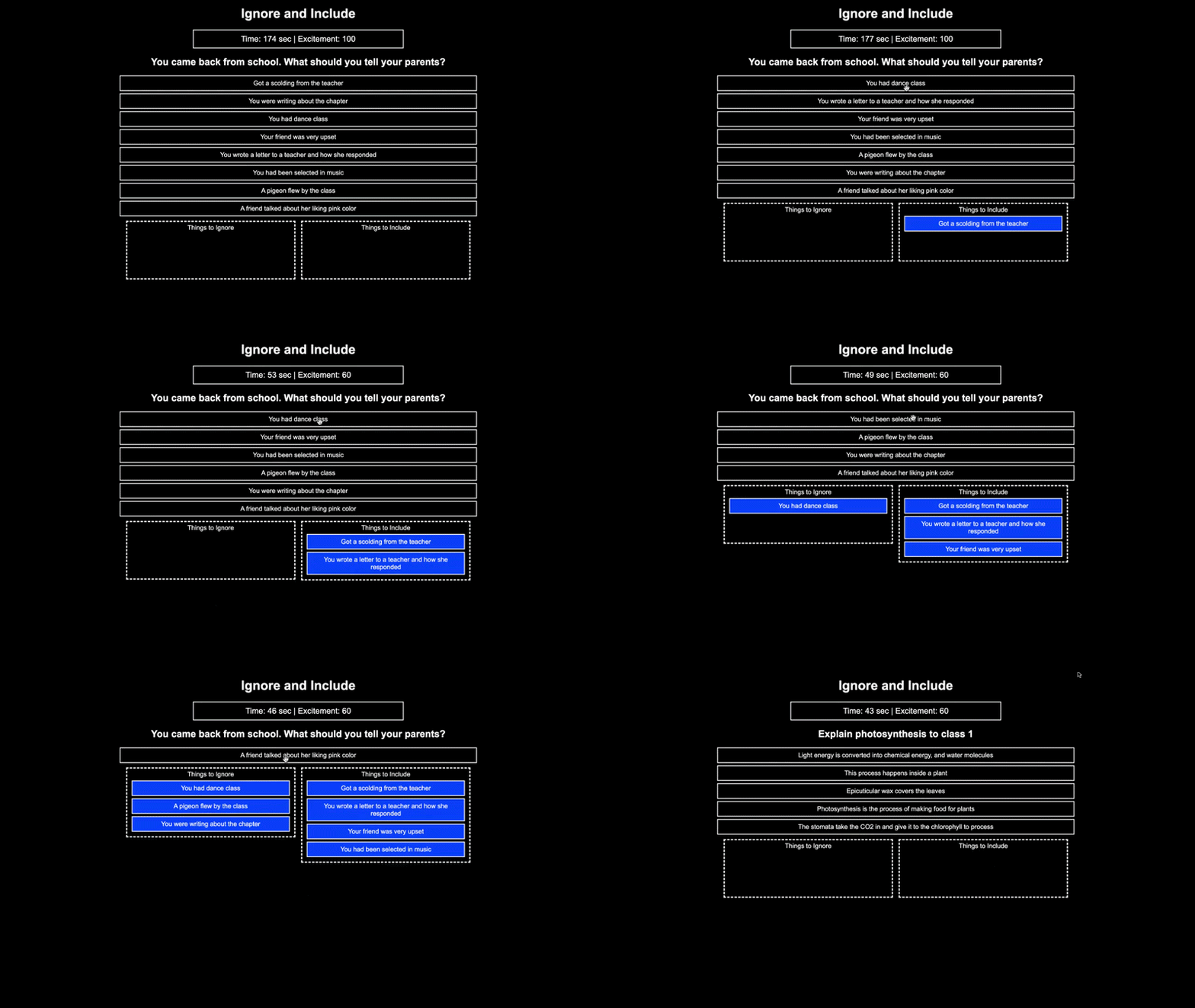
Ignore and Include

Mission: Explain things as nicely as you can in limited time.

Variables

Time — 60 seconds
Excitement — 100 points

Unexpected Variable
The excitement of the audience dropped. You can either continue going on and on, losing more excitement — or you can try to make things fun and get to the point.

Situation 1: You have just come back from school. You are trying to tell your parents what happened today. How would you sort out your day?

Options: Got a scolding from the teacher / You were writing about the chapter / A friend talked about her liking pink colour / A pigeon flew by the class / You had dance class / You wrote a letter to a teacher and how she responded / You had been selected in music / Your friend was very upset

Buckets: Things to Ignore / Things to Include

Answers: Include: Got a scolding from the teacher / You had been selected in music / You wrote a letter to a teacher and how she responded / You had dance class / Your friend was upset
Ignore: You were writing about the chapter / A friend talked about her liking pink colour / A pigeon flew by the class

Situation 2: You are explaining photosynthesis to a class one student. How would you explain it?

Options: Photosynthesis is the process of making food for plants / The stomata take the CO2 in and give it to the chlorophyll to process / This process happens inside a plant / Light energy is converted into chemical energy and water molecules / Epicuticular wax covers the leaves

Buckets: Things to Ignore / Things to Include

Answers: Include: Photosynthesis is the process of making food for plants / This process happens inside a plant
Ignore: The stomata take the CO2 in and give it to the chlorophyll to process / Light energy is converted into chemical energy and water molecules / Epicuticular wax covers the leaves

Situation 3: You are trying to convince your friends that your game is the best. How will you sort your thoughts?

Options: The game is quick and it will be fun / I want you to listen to me / Why are you not listening to me? / In this game you can learn how to cartwheel

Buckets: Things to Ignore / Things to Include

Answers:Include: The game is quick and it will be fun / In this game you can learn how to cartwheel
Ignore: I want you to listen to me / Why are you not listening to me?

Instructions for ChatGPT: Single HTML file. Black background, white font and buttons. Title "Ignore and Include" centred at top. Variables in a box below title — time as a live countdown timer. Options are draggable into buckets. Wrong bucket — penalty of 2 minutes and 40 excitement points. Game over when excitement or time hits zero — Game Over line and Play Again button appear. Play Again restarts the game. Correct situation completed — next situation appears. All situations completed with excitement and time above zero — You Won screen with Play Again button. Buckets should be clearly visual. Correctly placed options turn blue. Answers are for ChatGPT's reference only — used to check whether the player is correct.
Look at Situation 2. She’s asking a nine-year-old player to decide what a class one student needs to know about photosynthesis. Epicuticular wax and chlorophyll processes (ignore). The process makes food for plants and happens inside a plant (include). The abstraction is not about what’s true. Everything on the list is true. It’s about what serves the audience.
That judgment, not what’s accurate but what’s useful for this person in this moment, is the sophisticated version of abstraction. And she built a game that makes the player practise it.
Design → Build → Ship
She wrote the design doc in one sitting. When the output came back, something was wrong.
She hadn’t specified the correct answers in the design doc: just the situations, the options, and the buckets. ChatGPT made its own interpretation of what should go in each bucket. And it penalised answers that were reasonable, things that could genuinely be argued either way depending on context.
I pointed it out. She saw it immediately.
The fix was precise: add the answers explicitly to the design doc, labelled clearly as reference for ChatGPT. Not for the player, the player still has to think. For the AI, so it knows what to check against.
She updated the design doc, sent a correction prompt, and the second version was clean.
One issue. One fix. Done.
What she wrote in her own reflection afterwards:
“All of these situations are my own experiences, from school or at home. This game is basically daily life but in game format. I have made many mistakes like this while explaining things to my parents or friends. If you don’t follow this, your audience will lose their excitement in what you’re trying to say.”
She wasn’t describing a concept. She was describing something she’d lived and built a game around so other children could practise it before they lost their audience in a park.
What this is actually building
The park moment is what I keep coming back to.
She’d been mid-explanation, adding rule after rule to a game her friends hadn’t agreed to play yet, watching their attention drift away in real time. She’d felt the cost of failing to abstract: the audience disengaging not because the idea was bad but because the communication buried it.
She built a game that trains the skill she’d needed in that moment. Not from a textbook definition of abstraction. From her own experience of what happens when you don’t do it.
That’s the thread running through all nine sessions. The concepts aren’t abstract to her. They’re named versions of things she’s already lived. Sequencing was the construction site she’d watched being built. Patterns were the feeding data she’d seen on my laptop. Conditions were the daily decisions around Vasuda. Debugging was the maths problem we traced line by line.
Abstraction is the friends in the park and the proposal that doesn’t include everything.
Each concept found its way to a game not because she was given a topic and told to design something. Because she had experiences, the concept gave those experiences a name, and the name gave her somewhere to put the design.
That’s what nine sessions of this builds. Not games. A habit of seeing the world as something designable.
Abstraction is where she learned that less, said precisely, lands harder than everything, said completely. ⚡️
What I understand now: She knew sequencing from the construction site. She knew patterns from the feeding data. She knew debugging from the maths problem. The series didn’t teach her to think this way. It gave her vocabulary for thinking she was already doing. That’s the most important thing I learned from building it with her.
What’s next
She was jumping by the end of the session, not because abstraction was exciting because she could count. Nine done, three left. And she told me something I hadn’t known: she’d been quietly thinking about the Sherlock Holmes game the whole time. Not waiting for permission to start planning. Already working through how it would need to use everything she’d built across the series.
Nine sessions in, she told me she’d been quietly planning the Sherlock Holmes game the whole time. I hadn’t known because she hadn’t said anything and she hadn’t said anything because she understood, at some point in the series, that the planning was hers to do. The moment she described the logic she’d worked out: conditions for clues, loops for investigation, decomposition for the case structure, I realised the series had already done what I hoped it would. She was thinking like a designer without being told to.
Conditions for the clue logic. Loops for the investigation. Debugging to find the missing piece. Decomposition to structure the case. Variables to track what the detective knows and doesn’t know.
She hadn’t said any of this out loud until now. She’d just been thinking.
Next up is variables: the things that change, and the systems that track them. And then functions. And then she builds whatever she’s been designing in her head for nine sessions.
The backlog is almost empty.
Your turn
Use this section as a reference before and after the session. The memoir above is our story. This is the kit for you to try.
The concept
Abstraction is ignoring the details that don’t matter right now and focusing on what does. At 8–12 the interesting version is audience-dependent abstraction. The same information abstracted differently for different people. What a class one student needs to know about photosynthesis is different from what a scientist needs to know. Both are correct abstractions. The skill is knowing which version serves this audience in this moment.
This session tends to move quickly because children already practise abstraction constantly. Every time they summarise, explain, or choose what to tell someone. The concept isn’t new. The deliberate version of it is.
Green flag: your child asks ‘who is this for?’ before deciding what to include. That question: audience first, content second is the instinct you’re building.
Try this
Ask them to explain the same thing to two different people. A concept from school, a game they like, anything they know well. First explanation is for a five-year-old. The second is for an expert. What stays in both? What changes? What disappears entirely? The thing that stays in both is the essential abstraction. What changes tells you something about audience. What disappears tells you something about what was never necessary in the first place.
Before the design challenge: a screen-free activity (15 minutes)
Give your child a topic they know well and ask them to explain it three times: once in thirty seconds, once in three sentences, once in one sentence. Each version is a different level of abstraction.
After all three: which version would you use if you had ten seconds with a stranger? Which if you had an hour with someone interested? Which if you had to write it on a badge?
This makes abstraction feel like a choice rather than a reduction. The one-sentence version isn’t inferior to the thirty-second version. It’s right for a different audience. That’s the concept in one exercise.
Going further
If your child races through this:
Give them a dense piece of text: a paragraph from a textbook, a news article, a set of instructions and ask them to abstract it down to one sentence that a ten-year-old could act on. Then ask: what did you leave out? Why? Then ask: what would you put back if the audience was a scientist? The act of adding things back is as revealing as the act of leaving them out. It shows what was essential versus what was contextual.
If your child needs more time:
Stay with the spoken version before the written or designed version. The three-explanation exercise: thirty seconds, three sentences, one sentence works as a conversation before it works as a design challenge. Let them explain verbally first, adjust based on your reaction as the audience, then try writing the design doc. The concept is easier to feel in speech than to design in text.
New here? Start with the series introduction. Parent’s Guide: Computational Thinking for Pre-Teens