 Made in Humane Club


She set aside three complete game ideas and started again. Not because they were broken. Because she understood that the concept required the player to decompose, not the designer.
The big problem and the small pieces
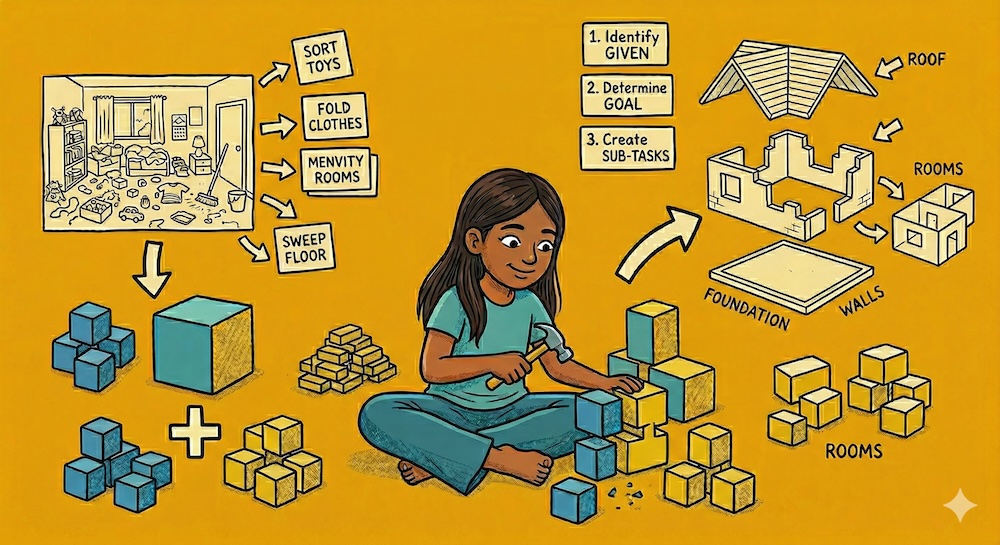
I started with the house renovation we’d done the previous year. We hadn’t hired an architect. We hadn’t started with a design board and a mood palette. We’d started with the structure: what was broken, what was unsafe, what had to be fixed before anything else could happen. Then layout. Then design.
Three phases. Each one had to be substantially complete before the next could begin. The renovation was one big problem made manageable by being broken into three smaller ones.
Then I gave her a closer example. A messy room. Not one task: pick up clothes, put them in the right place, make the bed, clear the surfaces, sweep, mop. Each one is small. Each one is completable. The room gets clean not because you tackle it as a whole but because you work through the parts.
And then maths. A complex word problem doesn’t get solved in one step. You identify what’s being asked. You extract the relevant information. You break the calculation into stages. You work through each stage. The answer comes at the end, not from seeing the whole, but from working through the pieces.
Same instinct across three completely different contexts. That’s decomposition.
I’ve used decomposition professionally for ten years. Every client project starts the same way, breaking a vague brief into phases, each phase into tasks, each task into decisions. I didn’t explain this to her during the session. But it’s why the house renovation came to mind immediately. The renovation was genuinely how I think about large problems. She’d watched it happen.
How she chose what to build
She came to the session with three game ideas already mapped out.
A mall construction game: break the project into floors, shops, infrastructure. A house building game: foundation, walls, roof, interiors. A sandwich assembly game: ingredients in the right order.
She’d done the decomposition herself. Listed the pieces, arranged them in sequence, designed a game around completing them in order.
I read through her notes. Then I asked: is this decomposition or sequencing?
She looked at it. “I’m… breaking it into pieces.”
“You are. But who’s doing the breaking? You’ve already broken it into pieces. The player just follows your sequence.”
She saw it. The player wasn’t decomposing anything. They were being handed a pre-decomposed problem and asked to execute it in order. That’s sequencing. Session one.
For this to be a decomposition game the player had to do the breaking.
She went quiet for a moment. Then: “So the player has to take a big thing and figure out how to split it up themselves.”
Exactly.
She thought about it. Then she picked up her pencil and started writing something completely different.
What struck me about that moment was the speed of it. She didn’t argue, didn’t try to salvage the ideas, didn’t ask for more time. She sat quietly for a moment, understood the distinction, and started writing something different. Three complete game ideas, set aside in one conversation. That kind of intellectual flexibility, the ability to let go of work when the frame changes, is rare. I don’t take it for granted
The design doc
She landed on numbers.
Given a number, break it into smaller numbers that add up to it. Not told how. Not given the pieces. Just given the whole, and asked to decompose it.
Level one: addition only. Take 6. Break it into parts using addition. There are multiple valid answers. The player decides.
Level two: addition and multiplication. Now the decomposition can use both operators. More ways to break it. More thinking required.
Level three: addition, multiplication, and division. The most complex decompositions. Thirteen. Twenty-eight. Numbers that require thought before the first block is moved.
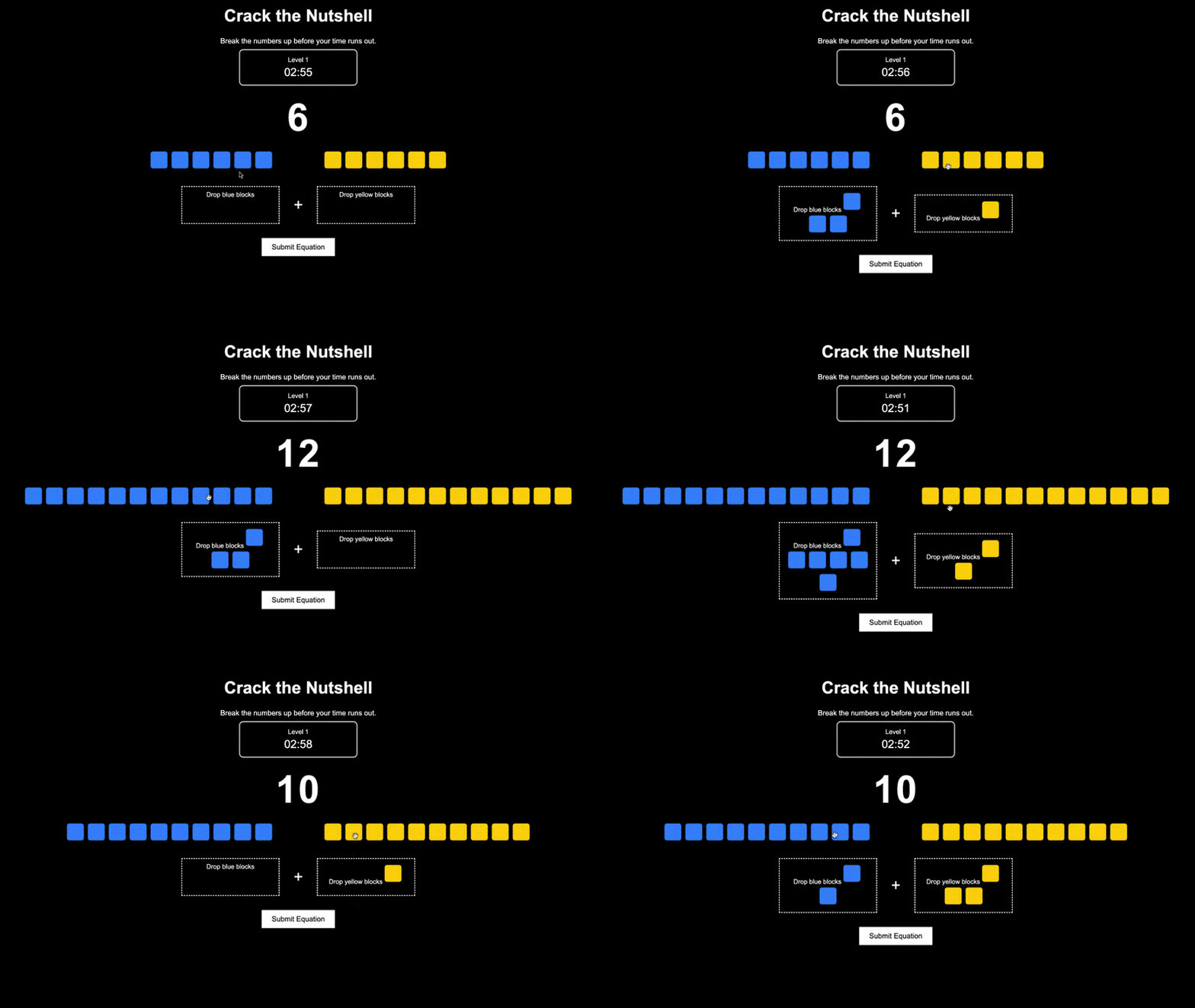
And the mechanic she designed to make it visual: coloured blocks. Blue blocks and yellow blocks, each representing a number. The player drags and groups them to form the equation. The decomposition becomes physical: you can see the pieces, move them, rearrange them until the equation is valid
That’s a clever design decision. Decomposition is an abstract concept. Blocks you can drag make it concrete.
Here is exactly what she wrote:
Crack the Nutshell

Mission: Break the numbers up before your time runs out.
There are three levels. Each level will be much more complex than the others.

Variables

Time — 3 minutes per question

Level 1

Operators: +

6 — 6 blue blocks, 6 yellow blocks
12 — 12 blue blocks, 12 yellow blocks
10 — 10 blue blocks, 10 yellow blocks
8 — 8 blue blocks, 8 yellow blocks
7 — 7 blue blocks, 7 yellow blocks

Level 2

Operators: +, ×

15 — 15 blue blocks, 15 yellow blocks
24 — 24 blue blocks, 24 yellow blocks
36 — 36 blue blocks, 36 yellow blocks
16 — 16 blue blocks, 16 yellow blocks
21 — 21 blue blocks, 21 yellow blocks

Level 3

Operators: +, ×, ÷

15 — 15 blue blocks, 15 yellow blocks
28 — 28 blue blocks, 28 yellow blocks
21 — 21 blue blocks, 21 yellow blocks
13 — 13 blue blocks, 13 yellow blocks
14 — 14 blue blocks, 14 yellow blocks

Instructions for ChatGPT: Single HTML file. Black background, white font. Title "Crack the Nutshell" centred at top. Mission written clearly below title. Timer shown per question — resets after each one. Blocks visually represented below the variables box. Player drags and drops blocks to form equations. Blue blocks together on left, yellow blocks together on right. Operator shown between the two groups. Game ends on wrong answer — Game Over with Play Again button. Correct equation — next question appears. All questions completed — You Won screen with Play Again button.
The three-level operator progression was entirely her design decision. Addition only, then multiplication, then division. Same mechanic at every level, progressively more complex decomposition required. A player who understands level one can reason their way through level three. They just have more tools and harder numbers.
Design → Build → Ship
The first output came back and I gave her four pieces of feedback.
The number being decomposed wasn’t prominent enough. It needed to be larger — the thing the player is working toward should be the most visible element on screen.
The operator drag-and-drop was unnecessary work. Level one uses only addition. If there is no other option, why make the player drag an operator into place? Remove it. Show the plus sign by default. Only introduce operator choice when the level actually offers a choice.
The blocks were alternating, blue-yellow-blue-yellow, which made it harder to group them mentally. All blue blocks together on the left. All yellow blocks together on the right. The visual grouping should support the mathematical grouping.
The word “variables” appeared as a label on screen. A player doesn’t need to know it’s called a variable. Remove the label. Just show the level name and the timer.
She took all four pieces of feedback, updated the prompt, and sent it.
The second version was the final version.
Four specific pieces of feedback. One correction prompt. Clean output.
What this is actually building
The feedback session is what stayed with me.
Four observations. Each one framed as a question the player would ask: not a design preference, not an aesthetic choice. The operator drag is unnecessary work for the player. The alternating blocks create friction. The number being decomposed should be impossible to miss.
She took each one and immediately understood why. She didn’t defend the original choices. She could see, once it was pointed out, that each issue was a gap between her intention and the player’s experience.
That’s the player perspective test from session five now applied to a build that was technically working but experientially wrong in four places.
The more interesting moment was earlier though. The shift from “I’ll break it down for the player” to “the player has to do the breaking.”
She’d arrived at session eight with three complete game ideas. All of them wrong in the same way. And when it was pointed out, she didn’t try to defend them or adapt them. She set them aside entirely and thought differently. She understood that the concept required the player to decompose, not the designer.
That clarity, knowing which job belongs to the designer and which belongs to the player, is one of the sharpest instincts she’s shown in the series.
Decomposition is where she learned that breaking a problem down is only useful if you’re the one doing the breaking. ⚡️
What I understand now: the feedback session, the four observations about the player’s experience, was the decomposition session working at its highest level. She’d decomposed the design problem correctly. She’d missed the decomposition of the player experience. When I named each gap, she could see it immediately. That’s what decomposition enables: once the parts are visible, the problems in each part become visible too.
What’s next
Crack the Nutshell is on her laptop. She hasn’t had anyone test it yet. Seven down and five to go. The Sherlock Holmes game is one concept away.
Next up is abstraction: knowing what to ignore is as important as knowing what to pay attention to. And the moment she had to explain something complex in ten words, chose carefully, and discovered that what she left out told her more than what she kept.
Your turn
Use this section as a reference before and after the session. The memoir above is our story. This is the kit for you to try.
The concept
Decomposition is taking something overwhelming and breaking it into parts you can actually work on. At 8–12 the interesting extension is knowing which job belongs to the designer and which belongs to the player: who does the breaking matters as much as how things are broken.
Your child already decomposes instinctively. They break big tasks into smaller ones, large problems into manageable pieces. This session makes that instinct deliberate and asks a harder question: am I breaking this for myself or for someone else?
Green flag: your child’s first response to a new challenge is to list the parts before starting. That ordering, decompose first then act, is the habit taking shape.
Try this
Pick the most overwhelming thing they have to do this week. Ask them to break it into parts. Then ask: what’s the smallest part? Can you break it further? At some point the parts become small enough to start. That point, where the overwhelming thing becomes a list of things you can actually do, is what decomposition produces. Finding that point is the skill.
Before the design challenge: a screen-free activity (15 minutes)
Write a large, vague task on a piece of paper. Like ‘plan a birthday party’, ‘clean the house’, ‘learn a new skill’. Ask your child to decompose it: what are the major parts? For each major part, what are the smaller tasks inside it? Go at least two levels deep.
Then ask: in what order do the parts need to happen? Are any of them dependent on each other? Does one part need to be complete before another can start?
This produces the same structure a professional project manager uses. It takes fifteen minutes with paper and a pen. The screen-free version is better here: seeing the decomposition spread across paper, with arrows showing dependencies, makes the structure visible in a way a digital list doesn’t.
Going further
If your child races through this:
Give them something complex from real life: a sports team’s season schedule, a school project brief, a recipe for a multi-course meal and ask them to decompose it fully. What are the major components? What are the sub-components? What has to happen before what? Then ask: which component, if it went wrong, would cause the most downstream damage? That last question is the advanced version of decomposition thinking i.e identifying the critical path.
If your child needs more time:
Stay with physical decomposition before abstract decomposition. Take a physical object: a bicycle, a mechanical toy, anything with visible parts and decompose it together. Name each component. What does it do independently? What would break if it were missing? The concept needs to be visible and tangible before it becomes abstract enough to design around.
New here? Start with the series introduction. Parent’s Guide: Computational Thinking for Pre-Teens