 Made in Humane Club



Some sessions are breakthroughs. Some are three days of rebuilding the same game until it’s good enough. And some are half a day, three prompts, one bug, and a clean finish.
Every action has a reaction
Cause and effect, I told her, is the relationship between an action and what follows from it. Pull a block from the base of a tower, the tower falls. Mix baking soda and vinegar, carbon dioxide forms. Push one domino in a chain and all of them fall.
She knew this intuitively. Every child does. What they haven’t done is precisely enough to design a system around it.
This was the session I’d been least certain about going in. Cause and effect felt almost too obvious. Every child knows actions have consequences. I wasn’t sure there was enough here to build a session around. What I didn’t anticipate was the gear chains. The moment she designed a four-gear chain with the direction question that’s when I understood what the concept could do at this age.
I asked her: what’s the difference between a cause and a coincidence?
She thought about it. “A cause actually makes the thing happen. A coincidence just happens at the same time.”
Right. And that distinction, between correlation and causation, is one of the most important ideas in science, data, and computational thinking. You don’t need to call it by those names at nine. You just need to feel the difference between “this happened because of that” and “these two things happened together.”
How she chose what to build
The idea came quickly. A prediction game where the player sees an action and has to choose the correct reaction from multiple options. Robots competing in real time. Three levels of increasing difficulty.
She sat down with her notebook, wrote the design doc, and came back with the first version of the questions.
I looked at the Medium and Hard levels and pushed back. The questions weren’t hard enough. They were cause-and-effect relationships, but obvious ones, the kind where you could guess without thinking. Medium and Hard should require the player to actually reason through a chain, not just recognise a familiar outcome.
She went away and came back with science questions and gear chains across every level.
Baking soda and vinegar producing carbon dioxide. A gear connected to three others in a chain: which direction does the last one turn? A plant receiving sunlight and water: what follows?
She already knew how gears work as she’d spent time working through mechanical puzzles online and had the logic of connected gears sitting comfortably in her head.
The design doc
Prediction Racers

Mission: Predict everything before the robots do. You have to beat your robot competitors by being fast and accurate.

Three levels: Easy, Medium, Hard. Complete all three to become the Reaction Racers champion and win a trophy.

Level 1 — Easy

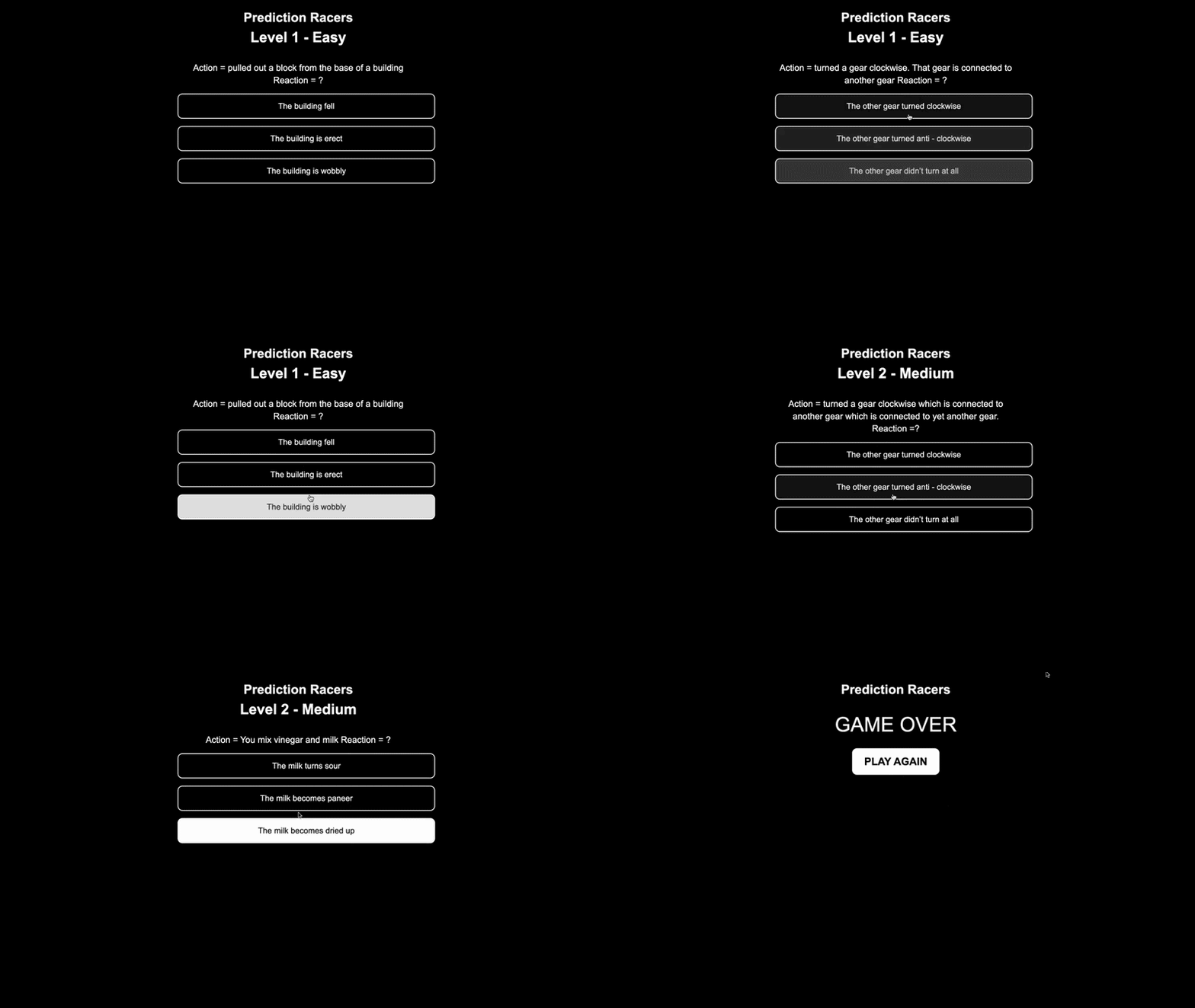
Question 1: Action = pulled out a block from the base of a building. Reaction = ?
Options: The building fell / The building is erect / The building is wobbly

Question 2: Action = turned a gear clockwise. That gear is connected to another gear. Reaction = ?
Options: The other gear turned clockwise / The other gear turned anti-clockwise / The other gear didn't turn at all

Question 3: Action = pulling a rope in a game of tug of war. Reaction = ?
Options: Makes no difference in the game / Makes the other side topple over / Helps your team win the game

Level 2 — Medium

Question 1: Action = turned a gear clockwise, connected to another gear, connected to yet another gear. Reaction = ?
Options: The last gear turned clockwise / The last gear turned anti-clockwise / The last gear didn't turn at all

Question 2: Action = you mix baking soda and vinegar. Reaction = ?
Options: Carbon dioxide is formed / Oxygen is formed / Nitrogen is formed

Question 3: Action = you mix vinegar and milk. Reaction = ?
Options: The milk turns sour / The milk becomes paneer / The milk becomes dried up

Level 3 — Hard

Question 1: Action = pushing one domino in a chain of equidistant dominos. Reaction = ?
Options: All the dominos fall / No dominos fall / Neither

Question 2: Action = turned a gear connected to three other gears in a chain, anticlockwise. Reaction = ?
Options: The last gear turns anti-clockwise / The last gear turns clockwise / Neither

Question 3: Action = plant receives sunlight and water. Reaction = ?
Options: The plant becomes dried up / The plant produces food / The plant's roots start rotting

Instructions for ChatGPT

- Make this a single HTML file
- There should be a black background.
- The Level name should be written on the top, in the middle
- There should be a Play Again button underneath the question in the middle
- If the player makes a mistake, the game should end immediately
- Once the game ends, the user should not be able to click any option.
- If the game ends, a white GAME OVER should appear
- When the player clicks the play again button, the GAME OVER should vanish
- The questions should keep getting shuffled
- Don't change or replace my questions.
- The play again button should be big and noticeable.
- The play again button should be tappable when the game is over
- When the player clicks the play again button, the game should restart
Look at the gear questions across all three levels. Level 1: one gear connected to one other — which direction does it turn? Level 2: a chain of three gears. Level 3: a chain of four, starting anticlockwise. The same cause-and-effect logic, extended one step further at each level. The player who understands the rule at Level 1 can reason their way through Level 3 — but they have to hold the chain in their head and follow it all the way to the end.
That’s not a harder question. That’s a deeper one.
Design → Build → Ship
The first output came back clean. The second fixed a detail in the progress bar. The third resolved a bug she hadn’t noticed herself: the confetti was falling below the game rather than from the top of the screen downward.
I pointed it out. She hadn’t caught it.
This is worth naming honestly: the eye for testing, the instinct to play your own game as a player rather than as the builder, is still developing. On the construction game she caught the sequencing error herself. On the pattern game her friend found the bugs. Here I found one before anyone else played it. Each session reveals a different gap in the testing instinct, and each one is useful information.
Once I pointed at it, she fixed it in a single prompt. She could describe exactly what was wrong: confetti appearing in the wrong position and the AI could act on that description precisely. The diagnosis was immediate. Only the noticing had to come from outside.
I find this pattern repeating across the sessions and I’m still not sure what to do with it. She fixes things well. She doesn’t always spot them first. The diagnosis is sharp; the noticing is still developing. I don’t think that’s a problem to solve. I think it’s just where she is, and it will close on its own. But I wrote it down because it’s honest.
Her commit message captures what changed: “I have changed the questions to science based questions. The confetti is a bright color. I have also added complex gear based problems on every level.”
What this is actually building
That’s the headline of this session, and it’s not a small thing.
Post one took a full day, a wrong turn, twelve prompts, and tears over a shuffling bug. Post two took a day and a lesson learned through a frustrating emoji incident. Post three took three days and a framework for thinking about sophistication vs complexity before the game was good enough to move on. Post four took half a day.
Nothing dramatic happened this session. That’s the point.
The habits that had to be built painfully in the first three sessions are starting to become automatic. The design doc came first without prompting. The questions were improved after one round of pushback without resistance. The prompt was tight enough that the build needed minimal iteration. The bug was fixed immediately once identified.
This is what consolidation looks like. Not a breakthrough or a struggle. Just someone who has practised something enough times that the hard parts are getting quieter.
There is a version of this series where every post is a dramatic story of frustration and discovery. That version would be dishonest. Some sessions are hard. Some sessions are half a day and a clean finish. Both are part of learning, and the easy sessions only exist because the hard ones came first.
Cause and effect. ⚡️
What I understand now: the half-day sessions are proof that the difficult sessions worked. You can’t have consolidation without something to consolidate. Post four is only unremarkable because posts one, two, and three were hard. I didn’t appreciate that in the moment. I was just relieved it went smoothly
What’s next
The Sherlock Holmes game is still in the backlog. She knows it’s coming. She stopped asking about it after the categorisation session. I think she’s started to trust that the tools are accumulating toward something.
Next up is conditions: when this, and only when this, then that. And the afternoon she spent reading the rules of a card game and finding every loophole in them before we’d even started playing.
Your turn
Use this section as a reference before and after the session. The memoir above is our story. This is the kit for you to try.
The concept
Cause and effect is the relationship between an action and what follows from it. At 8–12 the interesting extension is chain thinking: effects become causes. Pull one thread and follow it forward. The gear questions in this session are the concept at its most elegant: same logic, one extra link at each level.
This session moves quickly. That is by design. After the density of the first three sessions, a clean half-day build is not a failure. It is evidence that habits are forming. Don’t try to make this session harder than it is.
Green flag: your child predicts a consequence before it happens and can trace the chain forward unprompted: not just the immediate effect but the effect of the effect.
Try this
Ask them to trace a decision they made this week forward through three links. What did it cause? What did that cause? What did that cause? Two or three links in the chain is a good session. The point is not the length but the habit of following the thread before assuming it stops.
Then ask: if you could change one link in the chain to get a different outcome, which one would you change? That question, minimal intervention, maximum effect, is the concept at its most useful and produces the sharpest thinking.
Before the design challenge: a screen-free activity (10–15 minutes)
Find any chain reaction in the house: dominoes if you have them, a line of books stood upright, or simply describe a decision together and trace its consequences forward. Change one link in the middle. What happens to everything downstream?
The physical version (actually toppling something) makes the concept visceral before it becomes abstract. A child who has felt a domino chain fall understands chain thinking differently from one who has only heard it described.
One question to end the physical activity: if you could change one link in the chain to get a different outcome, which one would you change? That question, minimal intervention, maximum effect, is the concept at its most useful.
Going further
If your child races through this:
Ask them to design a Level 4 where every question involves a chain of at least four links. The design challenge is making each link feel logical rather than arbitrary. Each consequence should follow from the previous one in a way a player could reason through independently.
If your child needs more time:
Start with physical chains before abstract ones. Dominoes, gear toys, or the morning routine traced forward: what happens if this step is skipped? The concept needs to be felt before it’s designed around. Don’t rush to the design challenge until the physical version has produced at least one moment of genuine surprise.
New here? Start with the series introduction. Parent’s Guide: Computational Thinking for Pre-Teens