 Made in Humane Club



How I Built a System to Run My Home (Part 1: Cleaning)
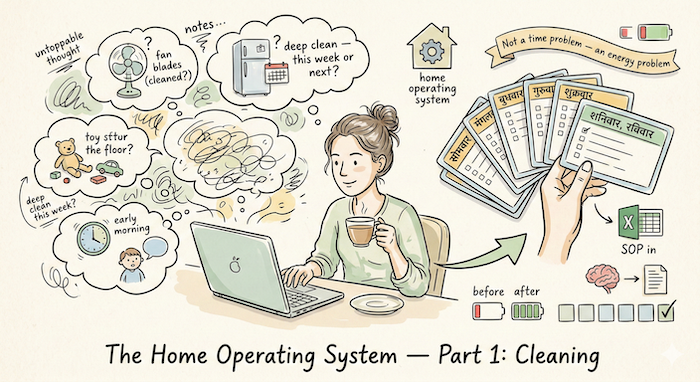

Because telling someone what to do every morning is not a system. This is.
As a working mom with two children, I am often asked how I “balance it all.”
I don’t balance. I architect.
For a long time I thought the exhaustion came from the hours. Then I realised it wasn’t the hours at all. It was the questions I couldn’t stop asking myself: when did we last clean the fan blades? Is the fridge deep clean this week or next? Why does the toy corner look like that again? None of it was hard. All of it lived in my head, because I’d never given it anywhere else to go.
Sahil Bloom calls it an energy problem, not a time problem. He’s right. The most draining part of my day wasn’t the ten-hour workday or the toddler tantrums. It was this invisible mental load; small, nagging, never-quite-finished; repeating on a loop before I’d even started my workday.
I don’t want to spend my morning energy on things that are necessary but not life-changing. I want to save it for what matters most: my children, my family, myself, my work.
So I stopped managing and started building a system.
I’m writing this from a position of privilege. I have someone who helps run my home. But the mental load doesn’t disappear just because you have help. It changes shape. Instead of doing tasks yourself, you’re directing, tracking, re-explaining them every day. That’s still a cognitive job. This post is about moving it from my head to a piece of paper.
Why Cleanliness is Half the Design
Before I get into the how, I want to share the why. Because it genuinely changed the way I see my home.
In data visualisation, there’s a principle I return to constantly: if the underlying structure is messy, the most beautiful design in the world cannot save it. A gorgeous dashboard built on chaotic data will always mislead, no matter how polished it looks.
My home was the same. We’d spent real money and real thought on how it looked. But the operational layer underneath: who does what, how often and to what standard was completely informal. It lived in my head, got transmitted verbally each morning, and degraded a little each time in translation.
I never consciously applied that lens to my home. But when I did, everything changed.
A house looks good 50% because of its design choices and 50% because of its cleanliness. Structure allows for beauty. I was investing all my attention in the first half and none in the second.
When every corner has a cleaning frequency and every task has a standard, the house stops being a source of stress and starts being a source of recovery.
Management is Not My Love Language
The first thing I had to acknowledge was that my house help isn’t the problem. She’s capable. The problem was that I had never given her a system she could follow independently. I gave her daily instructions instead of a standing operating procedure. There’s a big difference.
I have no desire to be the “nagging auntie” who follows someone from room to room. It is socially exhausting and intellectually unfulfilling. Telling someone what to do every single morning is a low-leverage task that consumes high-level cognitive energy. And the worst part? It doesn’t even work well. Verbal instructions drift. Standards slide. The same things get missed because nobody wrote them down.
My rule became: if I have to say it twice, it belongs in the SOP.
Once I stopped hovering, the quality of work actually went up. Nobody likes being watched over their shoulder. When you give someone a clear definition of “done” and a predictable weekly rhythm, you give them ownership. She isn’t waiting for my instructions each morning anymore. She’s executing a plan she understands. That shift happened not because I demanded more, but because I finally communicated clearly.
How It’s Built: The Framework
The core insight (borrowed straight from how I think about data) was to stop organising tasks by room and start organising them by frequency.
Most household task lists are room-based. The problem is that tasks in the same room have completely different urgencies. The kitchen counter needs attention every day. The inside of the store room needs it once a month. Lump them together and the daily tasks always crowd out the periodic ones until the periodic ones are an emergency.
So everything got sorted into five levels:
| Level | Frequency | What it covers |
| Daily | Every day | The essentials: sofa, floors, kitchen, washrooms, plants, entrance, garbage |
| Weekly | Mon – Fri | One deep-clean focus area per day, spread across the week |
| Weekend | Sat & Sun | Outdoors eg: terrace, staircase, railings, common areas |
| Bi-Weekly | 1st & 15th | Easy to forget, hard to ignore eg: fans, switches, RO cabinet etc. |
| Monthly+ | Monthly / Quarterly | The big resets eg: fridge interior, store room, shoe rack, wardrobe organization |
Most household chaos lives in the weekly level and above. Everyone knows the daily stuff that needs to be done. But when did someone last clean the window tracks? Or wash the detergent tray in the washing machine? Without a rotation, those tasks drift until they’re suddenly a problem and by then they feel like a crisis because they’ve been invisible for so long.
Defining “Done”
This was the most uncomfortable realisation of the whole process. I had never told anyone what “clean” actually means.
I said “clean the bathroom.” The bathroom got cleaned. But did she wipe the chrome dry, or leave water spots? Did she scrub the base of the toilet or just the bowl? Did she move the laundry basket to get underneath? I didn’t know because I’d never said.
So for every task I added a Definition of Done. How do I know this is finished?
Washroom floors: sweep dry area → mop dry area → wash and mop wet area. Move laundry basket and clean underneath.” Eight seconds to read. Every ambiguity gone.
I also added four global rules at the top, above everything else: things I’d always cared about but had never actually said out loud:
- No water marks on glass, chrome or tiles. Always dry after cleaning
- Wash hands before each new task and before touching the baby
- Always dust before mopping. Dry tasks before wet
- If a task can’t be done today, say so immediately. Don’t skip silently
The Capacity Problem
This was the biggest structural mistake in the first version, and I came embarrassingly close to not catching it.
She works 9am–6pm. Lunch is 30-45 minutes. And for roughly half the day (mostly mornings) she’s the primary caretaker for my toddler. That leaves approximately 3.5 to 4 hours of actual cleaning time, concentrated in the afternoon.
My original SOP assumed eight uninterrupted hours.
When I calculated Tuesday’s load, it came to over six hours of cleaning. She had three and a half.
The fix was twofold. First, I split every day into two explicit blocks:
- Morning block (9am–1pm): Baby care is primary. Only light, interruptible tasks happen here. About 75 minutes of work spread across 4 hours around the baby’s routine.
- Afternoon block (1:30pm–6pm): All core cleaning, in sequence. Total ~133 minutes of structured work.
The Communication Problem: She Reads Hindi, Not Excel
After spending days designing this system, I hit a wall I should have seen coming.
My house help has low literacy and reads only Hindi. A colour-coded Excel spreadsheet with ~70 rows means nothing to her.
I went through a few options before landing on what actually works:
What didnt work
- Printed Excel checklists: too much text, English, intimidating
- Pre-recorded Voice Notes: plays once, in sequence, and disappears. If she forgets task three while doing task two, the note can’t help her.
- Complex apps: too many steps for someone not comfortable with smartphones
What worked
The final format is simple: one A4 page per day of the week, printed and laminated. Big day name at the top. Morning tasks. Afternoon tasks in sequence. The day’s special deep-clean task at the bottom in bold. Seven cards. She picks up Monday’s card on Monday.
Before I laminated anything, I sat down with her and went through each card: “Tell me what you’d do today. What does this mean?” When she could walk me through it in her own words, I got it laminated. That conversation was the real handover. Not the printing. Not the system.
The irony of being a systems person is that you can fall in love with the sophistication of the solution and miss the simplicity of the problem. She needed something she could glance at, return to mid-task, and tick off. That’s a checklist. It always was.
The SOP Document Itself
The full system lives in a two-sheet Excel file.
Sheet 1: Master SOP
Every task is organised by frequency level and day, with the task and its Definition of Done in the same cell, a time estimate, and the assigned day. Row numbers auto-update when rows are added or removed
Sheet 2: Daily View
A fully formula-linked view of the same data. Every cell references the Master SOP. Change anything there and it reflects here instantly. This sheet has an autofilter on the Day column. Filter to ‘Tuesday’ and you see every Tuesday task, its time estimate, and its Definition of Done. Nothing is hardcoded. Nothing gets out of sync.
The SOP is for me: to design, audit, and update the system. The one-pager, laminated Hindi cards are for her: to know what to do each day. Same system. Different audiences.
What I Learnt
You cannot delegate what you haven’t defined.
Every task I couldn’t write a Definition of Done for was a task I hadn’t actually thought through. The discipline of writing ‘done when…’ for every task forced me to be explicit about standards I’d been carrying implicitly for years.
Frequency is more important than completeness
It’s better to have 50 tasks that always get done than 80 tasks that are only half-done. The load-balancing exercise was humbling.
The communication medium matters as much as the content
The most detailed SOP in the world is useless if it’s in a format your house help can’t access. Designing for the actual user with low literacy, Hindi and phone-native forced me to think about delivery, not just content.
What Actually Changed
Even after the system was built and laminated and handed over, I kept sending reminders. “Don’t forget the balcony today.” “Fans are due this week.” I couldn’t let go.
What if she doesn’t look at the card? What if her version of clean and my version are different? What if something slips?
I had built a system and then refused to trust it. Which, if you think about it, meant nothing had actually changed.
What helped was setting a fixed two-week trial: no interference, no verbal additions.
Whatever happened, happened. I’d assess at the end. That boundary is what finally made the system work, because it made me stop being the system.
Two weeks in, I can’t give you a number for time reclaimed. I haven’t measured it precisely, and I’m sceptical of anyone who claims to quantify mental load in hours. But I can tell you what feels different.
My mornings are quieter. Not quieter in the house; my two-year-old sees to that; but quieter in my head. The automatic inventory scan I used to run when I woke up, the low-grade anxiety about what was being missed, the feeling of being responsible for information that had nowhere to live but inside me — that’s mostly gone.
The house doesn’t just look clean now — it runs. A clean house is a state. A house that runs is a system.
I also want to say this honestly: there are still messy days. Weeks when the system slips, when the deep clean doesn’t happen because something came up, when the toy corner looks exactly like it always did. That’s life with two small children and a full-time job. The system doesn’t eliminate disorder. It gives disorder somewhere to recover to.
And there are still things I’m figuring out. The quarterly tasks haven’t run yet: first one is in April. The bi-weekly tasks need a separate reminder note on those days. I’ll update when I know what these look like in practice.
The Short Version
If you want to stop being the operating system of your own home:
- Write every task down and assign it a frequency, not a room.
- Write a one-sentence Definition of Done for each task.
- Design the communication tool for the person using it, not the person who built it.
- Set a fixed trial period and actually let it run.
The last one is the hardest.
Building took three days. Trusting it took two weeks.
The building was the easy part.
The Template
I’m sharing everything I built: the full SOP with ~70 tasks and Definitions of Done, the frequency framework, and the seven Hindi daily cards ready to print and laminate.
I’m sharing it because starting from a blank page when you’re already exhausted is its own kind of cruelty. The structure is there. The categories are figured out. The definitions are written.
Your job is to adjust it to your home. Add what’s missing. Remove what doesn’t apply. Change the standards to match yours.
It’s a starting point, not a prescription. Your house is not my house. But the framework should save you a few days and hopefully a little of that mental filing cabinet space.