 Made in Humane Club



Twelve sessions. Twelve games. One that had been waiting since day one. When it was finally done, she didn’t stop. She picked up her notebook and started writing a book.
I didn’t teach anything in session twelve. That was the point.
The free build is the test. Not of what she remembered, but of what had become instinct. Sequences, patterns, categorisation, cause and effect, conditions, loops, debugging, decomposition, abstraction, variables, functions all 11 concepts across 11 sessions. Here, she could use any combination of concepts to make a game work.
How she chose what to build
She came to the session with a clear idea, theme, and a clear sense of what the game needed to do. She wrote the design doc diligently and without overcomplicating it: a deliberate choice after eleven sessions of learning what happens when a design has too many moving parts.
The inspiration was Sherlock Holmes. She’d been reading the books. She’d been thinking about the game for eleven sessions. But she named it The Detective Case because that’s what a player needs to understand, not which fictional detective inspired it. Her uncle works at Apple. So Apple became the setting.
The design doc
The Detective Case

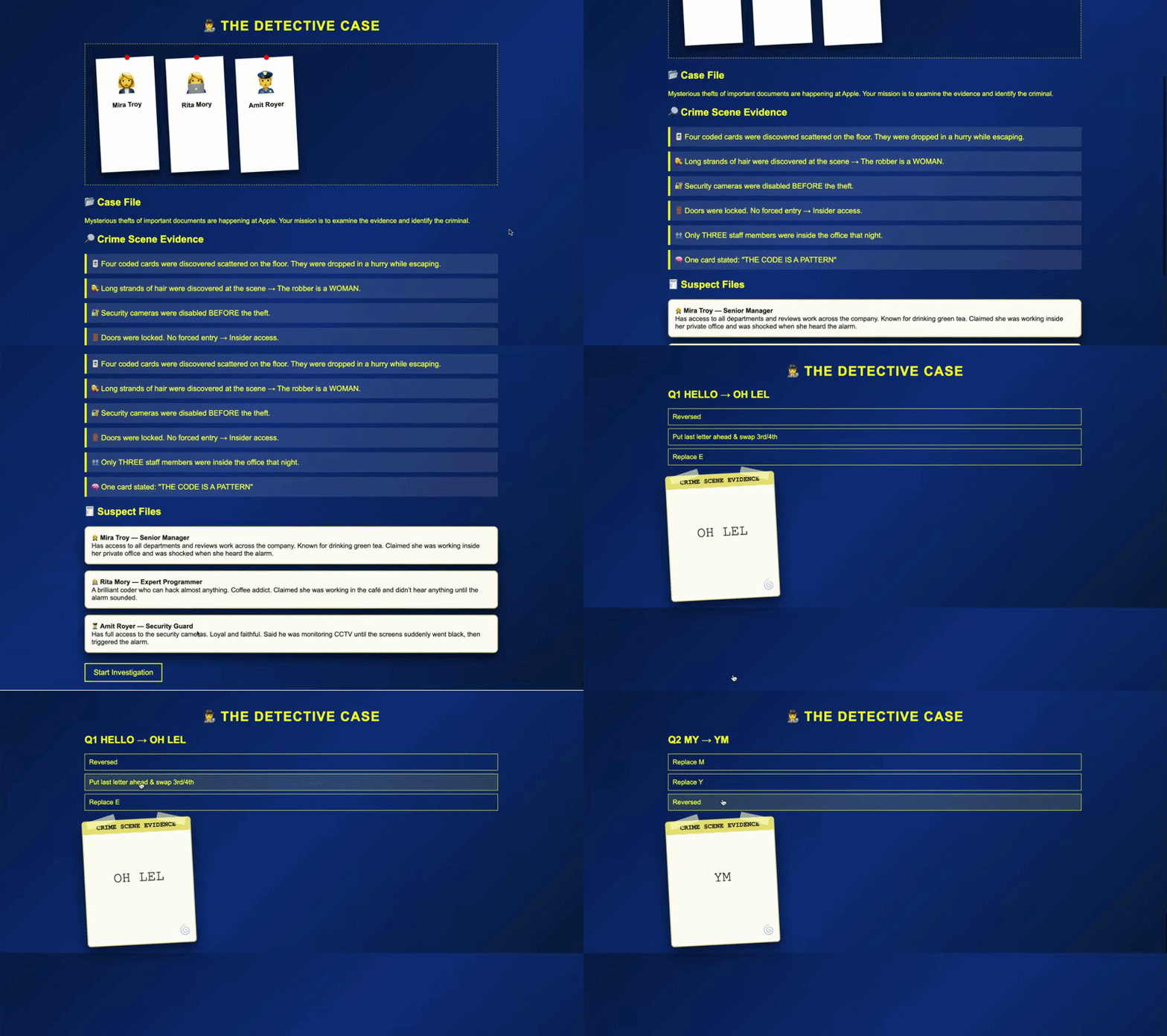
Case: Mysterious thefts of important documents are happening at Apple. Find out who the robber is.

Clues:

- At the robbery scene, 4 cards are found on the floor with something written on it. Evidently, they were dropped in a hurry. For, after them, there are muddy footprints hurrying away.
- The robber seems to be a woman as long strands of hair were found.
- The 4 cards found had some kind of code which needed to be cracked in order to find the thief.
- There was a card which said, “The code is a pattern.”

Suspects:
Mira Troy — Rita Mory's boss. Reviews work done and has access to everything in the building. One of the most senior people. She loves green tea. On the night of the theft, she was sitting in her personal office.

Rita Mory — Brilliant coder. She can hack anything and has the best skills in the entire company. She is a coffee addict. On the night of the theft, she was said to be in the café, working with her coffee.

Amit Royer — Security guard. Has access to the security cameras. Does not know English. A very loyal and faithful guard. He loves tea. Was said to be faithfully watching the CCTV until it went black.

Cards found at the scene:
Card 1: OH LEL
Card 2: YM
Card 3: EANM
Card 4: SI IATMORYR

Question 1 - What code did the robber use to code this word on Card 1, if the coded version is OH LEL and the uncoded version is HELLO?

Options - Reversed all the letters    Put the last letter ahead, then swapped the now 3rd letter with the 4th letter   Replaced E with H
Answer - Put the last letter ahead, then swapped the now 3rd letter with the 4th letter

Question 2 - What code did the robber use to code the word on Card 2, if the coded version is YM and the uncoded version is MY?

Options -  Replaced M with Y    Replaced Y with M  Reversed all the letters
Answer - Reversed all the letters

Question 3 - The code is a pattern. If this is true, then what is the uncoded word for Card 3’s coded word, “ ENMA” ?

Options - Name      Mena     Mean
Answer - Name

Question 4 - Now that you know the code, uncode what is written on Card 4. If you finish this, you will be able to find the thief.

Options - Is Rita Mory   Is Mira Troy    Is Amit Royer
Answer - Is Rita Mory

Instructions for ChatGPT
- Make this a single HTML file.
- The background should be dark blue. There should be a magnifying glass on the left side of the page.
- The font and button colour should be yellow.
- The title should be “ The Detective Case”.
- Underneath the title, the case should be written.
- Underneath the case, the clues should be written.
- Underneath the clues, The suspects should be written. The suspect’s description should also be written.
- Underneath all of this, there should be a “ Next” button.
- When the Next button is clicked, the suspects and clues should go away and the questions should appear.
- Below the questions, the options should be there. These options should be clickable.
- Under the options, the respective cards should be there.
- The Answers are for ChatGPT to check whether the player is solving the questions correctly.
- If the player does something wrong, the game should get over and a line saying, “ The Criminal got away” should appear with a Play Again button.
- The Play Again button should restart the entire game.
- Once a question is answered, the next question should appear.
- If the player succeeds in all the questions, a “ You Caught the criminal” line should appear with the play again button.
Look at the suspects: Mira Troy. Rita Mory. Amit Royer.
She’d been reading Sherlock Holmes. She knew that Holmes stories use anagrams as clues (names that contain hidden information for the careful reader). She designed all three suspect names as anagrams of each other. The same letters, rearranged. The person who notices that has already found something the game doesn’t tell them to look for.
That’s a hidden layer of design. Built in deliberately. For the player who looks carefully.
And the cipher on the cards(the coded messages the robber left behind) is a direct callback to the Secret Spy game from session eleven. She used the function she’d built in the previous session as a mechanic in this one. The cipher is a function. Input goes in, transformation is applied, output comes out. She knew that when she designed it.
The design constraint is also gone. Dark blue background with yellow font. After seven sessions of black and white, she made a deliberate visual choice for the game she’d been waiting to build. That choice belongs to this game specifically. It earned the colour back.
Design → Build → Ship
She built it the way someone builds something they’ve been thinking about for eleven sessions.
No confusion about the mechanic. No wrong turn to navigate. No feature built because it seemed impressive rather than because it served the player. The design doc was precise because the thinking behind it had been running quietly in the background since day one.
The brief was tight. The output reflected that.
She was happy building it. Genuinely, completely happy — the kind of happiness that comes from finally doing the thing you’ve been working toward. But there was something else alongside the happiness that I hadn’t expected.
Calmness.
She’d arrived at the moment. And she was ready for it.
I’d been braced for the excitement — she’d been waiting eleven sessions. The calmness was what I hadn’t prepared for. It told me something the excitement couldn’t: she hadn’t been waiting to arrive. She’d already been here.
What this is actually building
Eleven sessions ago she slumped back in her chair because I told her she couldn’t build the Sherlock Holmes game yet. She needed more tools. She didn’t have them.
Now she did.
The anagram names — she got that from reading the books and thought carefully enough about it to build it into the design. The cipher mechanic — she recognised it as a function and connected it deliberately to what she’d built in session eleven. The Apple setting — personal, specific, grounded in someone she knows. The clear clue structure, the three suspects, the four coded cards — decomposed cleanly into a game a player can follow without the designer holding their hand.
She used everything. Not because she was asked to. Because she was ready.
That’s what eleven sessions actually built. Not the games. The readiness. The instinct to reach for the right tool at the right moment without having to think about whether she has it.
Sequencing is in the order the clues are revealed. Patterns are in the cipher the player has to decode. Categorisation is in sorting suspects by what they could and couldn’t have done. Cause and effect is in the chain of deduction from clue to conclusion. Conditions govern which suspect is possible given each clue. Loops run through the evidence until the picture is complete. Debugging happens when a deduction turns out to be wrong. Decomposition breaks a theft investigation into manageable pieces. Abstraction filters the relevant clues from the irrelevant details. Variables track what the detective knows and doesn’t know. Functions encode the cipher that the robber used.
She didn’t plan all of that. She just built the game she’d been imagining. And all of it was there.
The Detective Case is where the backlog finally emptied. ⚡️
What I understand now is that the backlog was never really about the game. It was a way of keeping the horizon visible. Every session had somewhere to aim. When she finally built it, the game was almost beside the point. What mattered was that she’d arrived with everything she needed. The tools were hers. She’d built them herself.
What’s next
Twelve sessions. Twelve games. One that had been waiting since day one.
She asked me at the end: what comes next?
I told her: whatever you want to build.
She thought about it for a few days. Then she came back saying she wanted to teach these concepts to other kids her age through stories. She sat down and wrote it.
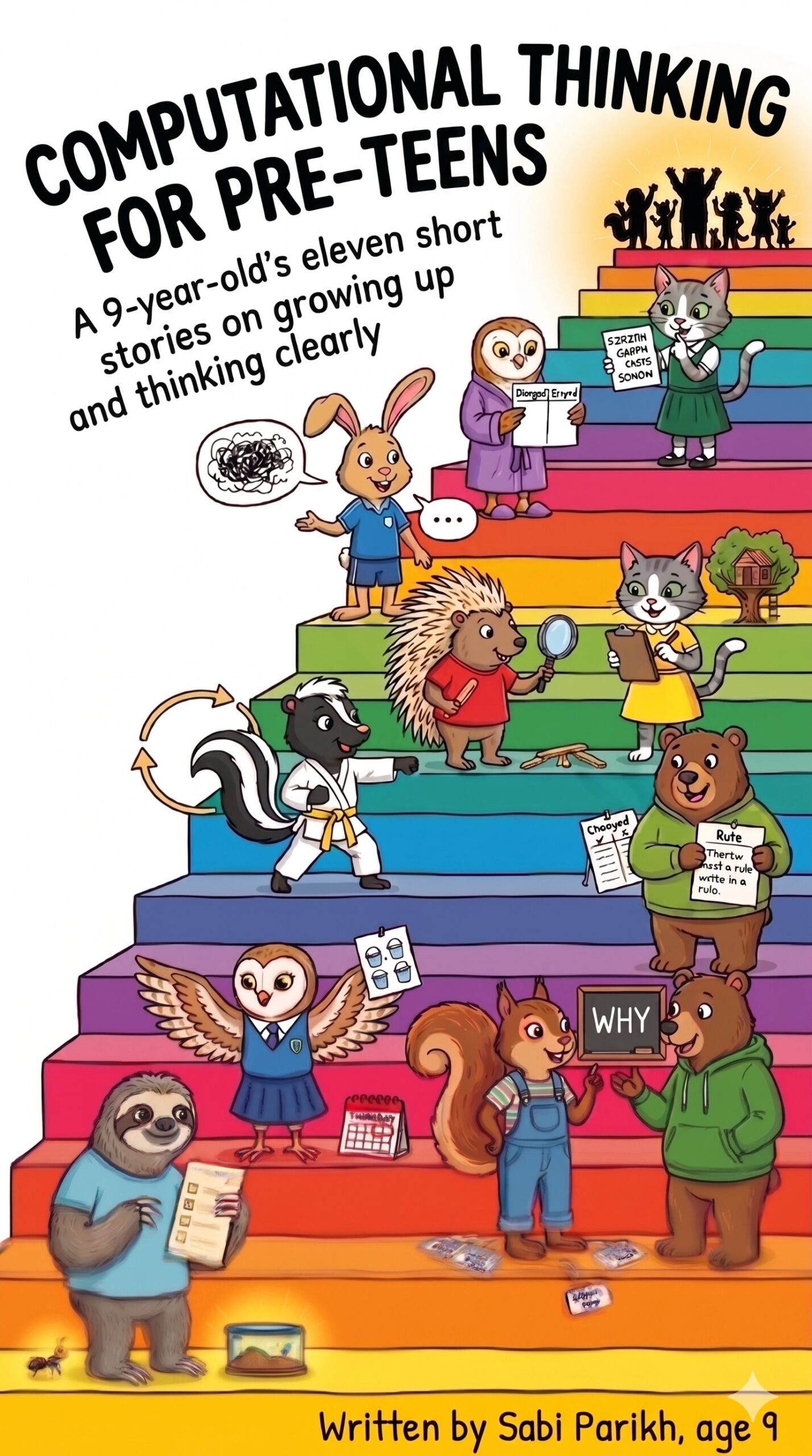
The result is Computational Thinking for Pre-Teens: eleven short stories on growing up and thinking clearly. It became her birthday gift to her classmates. Not something bought. Something built.
You can read it here: narishakti.in/books/computational-thinking-for-pre-teens
New here? Start with the series introduction. Parent’s Guide: Computational Thinking for Pre-Teens