 Made in Humane Club



Signals in the Noise: How Data Helped Me Understand My Newborn in the First 90 Days
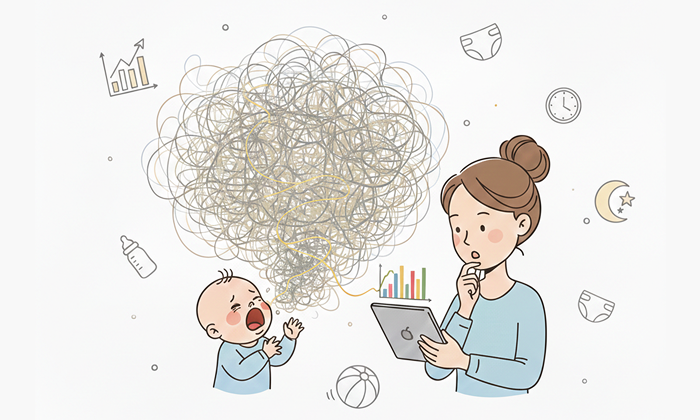

They say you can’t manage what you don’t measure. But with a newborn, can you really manage anything?
With my first daughter, Sabi, everything felt chaotic. I was a nervous first-time mom dealing with a colicky baby and a painful case of mastitis. So when Vasuda was born, I wasn’t just focused on breastfeeding. I really wanted to understand her.
I’ve spent the last 10+ years working in data visualization, so I naturally look for patterns. In the middle of newborn fog, charts felt easier to trust than my tired memory. Instead of trying to remember everything, I started logging it. Not because I wanted perfection, but because it helped me make sense of our days when everything felt unpredictable.
For ~12 weeks, I tracked every activity across six areas:
- Feeding: Left, right, bottle.
- Sleep: Awake and asleep times.
- Diapers: Wet, dry, and mixed.
- Leisure: Tummy time, play time, bath time, and outdoors.
- Health: Medicines, vaccinations, and temperature.
- Growth: Weight, height, and head circumference.
When I looked back at more than 3,000 rows of data, I found patterns I would have completely missed otherwise. Here are ten things that data quietly taught me about my daughter (and myself).
1. Faster Feeding is a Sign of Strength
Early in the logs (mid-May), nursing sessions often dragged on for 20–25 minutes.
- The Hidden Data: By late July, the average duration of a full feed dropped to just 8–12 minutes.
- The Insight: She wasn’t getting less milk; she was becoming a “Pro.” Her suction got stronger, and my let-down became faster. Seeing this duration drop saved me from worrying that she was “quitting early”. She was just getting efficient!
2. Wet Diapers: The Silent Sign of a Full Belly
During the “Poop Strike” (where she didn’t go for 4-5 days), I was terrified she was dehydrated.
- The Hidden Data: I noticed that even when “Dirty” diapers were zero, her “Wet” diaper count stayed consistent at 6–8 per day.
- The Insight: This was my ultimate supply-reassurance tool. The data told me: If the output of water is steady, the input of milk is sufficient.
3. The “Double Feed” Strategy for Longer Nights
Everyone asks how she started sleeping 6 hours at a stretch by Month 3. The secret was in the “Tanking Up” pattern in the late-evening logs.
- The Pattern: Between 8:00 PM and 10:30 PM, Vasuda would often take two “back-to-back” feeds (one Right, one Left) with less than 45 minutes between them.
- The Result: This “cluster” right before her main sleep window acted like a fuel tank. On the days she had this double-feed, her first sleep stretch was consistently 90 minutes longer.
4. Hunger Spikes Predict the Scale
I noticed that her growth wasn’t a slow, steady line; it happened in jumps.
- The Data Trace: About 48 hours before a recorded weight jump (like her move toward 5.7kg on July 27th), the logs show a “Feeding Frenzy.” She would suddenly jump from 8 feeds a day to 12.
- The Lesson: Now, when she gets “extra hungry,” I don’t worry that my supply is low. I know she’s just prepping for a growth spurt. The data predicts her growth before the scale did.
5. Nursing as Comfort, Not Just Food
When Vasuda got a common cold, her nursing pattern shifted dramatically.
- The Hidden Data: On sick days, nursing frequency was almost steady, but the sessions were significantly shorter.
- The Insight: She wasn’t hungry; she was using nursing as a “natural saline drop” and a pain reliever. She was seeking comfort and soothing rather than full, long meals and I just let her cuddle-nurse
6. Active Evenings Lead to Quiet Nights
I had a strict rule: No naps between 5:00 PM and 8:00 PM.
- The Proof: My “Leisure” logs show that on days we clocked at least 45 minutes of Tummy Time in this window, her 3:00 AM wake-up was a “business trip”—she would feed and go right back to sleep. If we skipped the evening “work,” she stayed awake for an hour in the middle of the night.
7. Less Feeding Time, More Rest for Mom
In those first few weeks, it felt like I was doing nothing but nursing. I was exhausted and felt like I had no time to even breathe, let alone work or rest.
- The Hidden Data: In my peak week in May, I was spending an average of 216 minutes (nearly 3.6 hours) every single day actively nursing (keeping aside all those few minutes of nursing here and there through the day and night). By the final week of July, that total had plummeted to just 50 minutes per day.
- The Insight: We often obsess over how many times a baby wakes up, but we forget to track the “workload” of the mother. My data showed that my daily nursing time dropped by nearly 75% in just ten weeks. Seeing this “time refund” appear on a chart was my biggest mental health win. It reminded me that the “marathon phase” is temporary; we weren’t just surviving, we were becoming an incredibly efficient team.
8. Why Learning New Skills Breaks Sleep
July 1 stood out. She barely slept and wanted to play constantly.
- The Reason: She had just started unlocking the skill of eye contact and facial recognition.
- The Lesson: The data reminded me that developmental leaps often look like regressions. She wasn’t sleeping badly. She was learning something new.
9. Using Data to Prevent Mastitis
Because I logged which side I started on, I caught a hidden habit: I was favoring my left side because it was more comfortable for me to hold her that way and allowing me to keep my right hand free to do other tasks.
- The Hidden Data: My left-side sessions were becoming 20% more frequent.
- The Insight: That imbalance could have led to blocked ducts. Using reminders to alternate sides helped me stay balanced and likely prevented mastitis that ruined my first breastfeeding experience.
10. Sleep is a Skill
When you’re in the thick of it, sleep progress feels like “one step forward, two steps back.” There were nights in July that felt just as hard as May, and I was convinced we weren’t making progress. But when I looked at the structural data of her sleep, I saw a massive transformation.
- The Hidden Data: In our first full week, her sleep was fragmented into an average of 13 separate sessions per day (a mix of tiny naps and short night stretches). By the end of 10 weeks, that number was cut exactly in half—averaging just 6 or 7 sessions per day.
- The Insight: Her total sleep hours didn’t change drastically, but the structure of sleep improved. She was moving away from the chaotic “fragmented” sleep of a newborn and toward the consolidated stretches of an infant. She was learning how to stay asleep longer. Sleep wasn’t just happening — it was developing as a skill.
The Takeaway: Peace of Mind is the Ultimate Metric
Looking at my CSV file now, I don’t see columns and rows. I see the story of a mother and daughter finding their rhythm.
If you’re in the “newborn fog,” I highly recommend tracking. Not to be obsessed with numbers, but to find the “why” behind the “what.” And sometimes, understanding alone is enough to ease the worry.